

Artificial Intelligence is no longer an experimental technology reserved for large enterprises. By 2026, AI has become a core foundation of modern marketing – enabling businesses to analyze customer behavior, personalize campaigns, and automate workflows with greater efficiency. In an increasingly competitive landscape, companies that fail to adopt AI risk falling behind as speed, data accuracy, and personalization become key success factors.
As consumer expectations continue to rise, marketers must produce higher-quality content, optimize campaigns faster, and leverage data more effectively to deliver seamless omnichannel experiences. As a result, using AI in marketing is no longer a trend, but a strategic advantage.
In this article, we will explore the 15 best AI marketing tools in 2026 that help businesses scale efficiently, improve ROI, and enhance overall marketing performance.
The Role of Using AI for Marketing
AI is transforming modern marketing at every level, from how businesses operate to how they engage with customers. Its role is clearly reflected in the following aspects:
- Transforming how businesses understand customers: AI shifts businesses from manual analysis to intelligent, automated systems that process large volumes of data and deliver real-time insights. This helps companies better understand customer needs, behaviors, and preferences.
- Predictive intelligence for customer behavior: By analyzing user behavior, purchase history, engagement patterns, and demographic data, AI can predict future actions and emerging trends. This allows marketers to build more accurate campaigns and improve conversion performance.
- Improving marketing operational efficiency: Many repetitive tasks such as email marketing, content management, ad optimization, social media scheduling, and lead scoring can be automated. As a result, marketing teams save significant time and are able to focus more on strategy development and creative work.
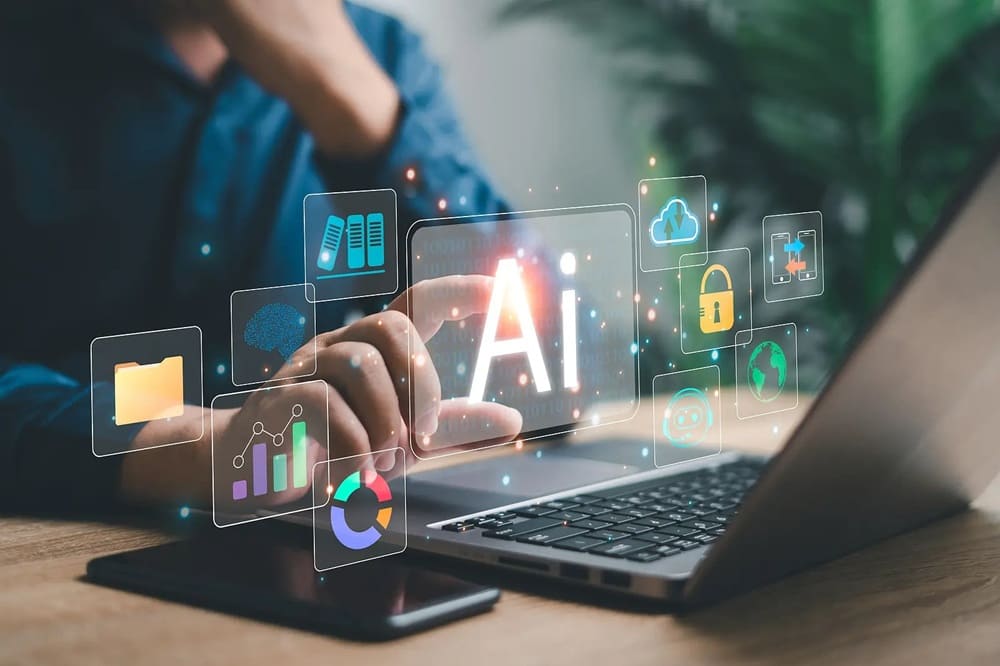
- Enabling personalized customer experiences: AI enables highly personalized experiences across multiple channels such as websites, ads, and emails. Content is tailored based on user behavior and preferences, increasing engagement and conversion rates.
- Enhancing decision-making speed and accuracy: With real-time data analysis, AI allows marketers to continuously monitor campaign performance and make timely adjustments. This leads to better optimization results and reduced risks during execution.
What are AI marketing tools?
AI marketing tools are software platforms powered by artificial intelligence technologies such as machine learning, natural language processing (NLP), predictive analytics, and automation algorithms. These tools help businesses improve marketing performance through intelligent automation, data analysis, content generation, and customer behavior prediction.
Unlike traditional marketing software, AI-powered marketing platforms continuously learn from user interactions and data patterns to improve results over time. They can automate repetitive tasks, generate optimized content, identify audience trends, and deliver strategic recommendations with greater accuracy.
AI marketing tools are commonly used for:
- Content generation and copywriting
- SEO optimization
- Email marketing automation
- Social media management
- Customer segmentation
- Predictive analytics
- Video and visual content creation
- Marketing workflow automation
- Customer relationship management (CRM)
- Advertising optimization
The growing adoption of AI marketing software reflects a broader shift toward intelligent digital transformation. Companies are increasingly investing in AI-driven marketing ecosystems to enhance agility, scalability, and customer engagement.
15 Best AI Marketing Tools You Should Try in 2026
ChatGPT – For AI content and ideas
OpenAI’s ChatGPT remains one of the most influential AI tools for marketers in 2026. It has become an essential solution for content ideation, blog writing, customer engagement scripts, email drafting, and campaign brainstorming.
Marketing teams use ChatGPT to accelerate AI content marketing workflows while maintaining creativity and consistency. The tool can generate social media captions, SEO-friendly blog outlines, ad copy variations, and personalized email sequences within seconds. One of its strongest advantages lies in conversational intelligence. Marketers can refine messaging strategies, simulate customer interactions, and develop brand communication frameworks more efficiently than ever before.
For businesses managing high-volume content operations, ChatGPT significantly reduces production time while supporting scalable content marketing strategies.
Surfer SEO – For data-driven content optimization
Surfer SEO has established itself as one of the leading AI-driven SEO optimization platforms for content marketers. The platform analyzes top-ranking pages in search engines and provides real-time optimization recommendations for keyword density, content structure, semantic relevance, and readability. This data-driven approach helps businesses create content aligned with search engine algorithms and user intent. Surfer SEO is particularly valuable for teams focused on improving organic traffic performance and maximizing search visibility in competitive industries.
Jasper AI – For advanced copywriting
Jasper AI is designed for businesses that require large-scale content creation with strong brand consistency. Unlike basic AI writing assistants, Jasper AI offers advanced tone customization, long-form content support, and marketing-focused templates for advertisements, landing pages, and email campaigns. Its ability to adapt to brand voice guidelines makes it especially useful for enterprise marketing teams managing multi-channel communication strategies.
Copy.ai – For quick content for ads and emails
Copy.ai specializes in generating short-form marketing content rapidly and efficiently. Marketers frequently use the platform to create ad headlines, promotional emails, product descriptions, and social media copy. The platform’s speed and simplicity make it ideal for fast-paced marketing environments where rapid content iteration is critical.
For startups and small businesses with limited marketing resources, Copy.ai provides an accessible way to scale content production.
Semrush – For keyword research and competitor analysis
Semrush continues to dominate the SEO and competitive intelligence landscape in 2026. Its AI-enhanced analytics help marketers uncover keyword opportunities, monitor competitor strategies, analyze traffic patterns, and optimize digital campaigns more effectively. Semrush is particularly powerful for businesses seeking comprehensive visibility into market positioning and search performance.
Ahrefs – For backlinks and SEO audit
Ahrefs is widely recognized for its advanced backlink analysis and technical SEO auditing capabilities. Strong backlink profiles remain critical for search engine rankings, and Ahrefs helps marketers identify link-building opportunities while monitoring domain authority performance. The platform also provides valuable insights into competitor backlink strategies and technical SEO issues that may impact organic growth.
>> Read more: A practical guide to AI-Powered Content Creation for beginners
Brandwell – For AI-generated SEO blog content
Brandwell has gained attention as an AI-powered platform focused on generating SEO-optimized long-form blog content. Its ability to combine keyword intelligence with AI-generated writing allows businesses to produce scalable blog strategies more efficiently. For content-heavy industries, Brandwell offers a significant productivity advantage.
Grammarly – For content editing
Grammarly remains an essential AI tool for content quality assurance. Beyond grammar correction, Grammarly provides tone analysis, clarity improvements, readability suggestions, and engagement recommendations. This helps marketers maintain professional communication standards across all content formats. For global brands, consistency and clarity in messaging are critical, making Grammarly a valuable addition to any content workflow.
Canva AI – For design and visual content creation
Canva has expanded its AI capabilities significantly, allowing marketers to create visual assets faster than ever before. Its AI-powered design tools assist with presentation generation, social media graphics, brand templates, and automated visual enhancements. For businesses without dedicated design teams, Canva AI democratizes high-quality visual content creation.
Midjourney – For creative image generation
Midjourney has become one of the most popular AI image generation platforms for creative marketing campaigns. Brands use Midjourney to create unique visual concepts, advertising assets, and campaign imagery without relying entirely on traditional graphic production processes. Its artistic flexibility makes it particularly useful for branding and storytelling initiatives.
Pictory – For turning text into videos
Pictory helps marketers convert written content into engaging video formats automatically. As video marketing continues to dominate digital engagement strategies, tools like Pictory enable businesses to repurpose blogs, articles, and scripts into visual content efficiently. This significantly improves content scalability across platforms such as YouTube, LinkedIn, and TikTok.
Lumen5 – For creating marketing videos
Lumen5 simplifies video creation through AI-powered automation and storyboard generation. The platform is ideal for marketers seeking professional-looking promotional videos without requiring advanced editing expertise. Its efficiency helps businesses maintain consistent video marketing output while reducing production costs.
HubSpot AI – For marketing automation
HubSpot integrates AI capabilities into CRM management, lead nurturing, email automation, and customer engagement workflows. Its AI-powered marketing automation features help businesses improve lead conversion efficiency and customer relationship management at scale. For companies seeking unified marketing ecosystems, HubSpot AI offers strong operational integration.
Zapier – For workflow automation
Zapier enables marketers to automate workflows between multiple applications and platforms. By reducing manual processes, businesses can streamline operations such as lead management, campaign reporting, customer notifications, and data synchronization. Automation efficiency has become increasingly important as marketing ecosystems grow more complex.
Salesforce Einstein – For customer analysis and personalization
Salesforce Einstein leverages AI-driven predictive analytics to deliver advanced customer insights and personalization capabilities. The platform helps businesses forecast customer behavior, improve targeting precision, and optimize customer engagement strategies based on real-time data intelligence. For enterprises focused on customer-centric marketing transformation, Salesforce Einstein remains a powerful solution.
>> Read more: Top free AI tools widely used and best in 2026
The Future of AI Marketing in 2026
The evolution of AI marketing technologies is accelerating rapidly. In 2026, successful marketing strategies are no longer defined solely by creativity but by the ability to combine creativity with intelligent automation and data-driven execution.
Businesses that integrate AI into their marketing ecosystems gain the ability to scale campaigns faster, personalize customer experiences more effectively, and optimize performance continuously.
However, adopting disconnected AI tools alone is not enough. Companies increasingly require integrated AI marketing solutions capable of centralizing data, automating workflows, and delivering strategic intelligence across the entire customer journey.
Transform and optimize your business marketing strategy with Lifesup AI
For businesses seeking a more comprehensive and enterprise-ready AI marketing solution, Lifesup AI is emerging as a powerful technology partner in the AI-driven marketing landscape.
Unlike standalone AI tools that focus on isolated functions, Lifesup AI delivers an integrated AI marketing ecosystem designed to help businesses optimize operations, automate workflows, and improve customer engagement through intelligent automation.
Key strengths of Lifesup AI’s marketing solutions include:
- AI-powered customer behavior analysis for deeper audience insights
- Intelligent marketing automation that reduces operational workload
- Personalized campaign optimization across multiple channels
- Centralized data management for improved decision-making
- Scalable AI infrastructure tailored for growing enterprises
- Enhanced lead generation and customer engagement strategies
- Real-time analytics for performance optimization
As competition intensifies in the digital economy, businesses need more than fragmented automation tools. They need intelligent systems capable of connecting marketing strategy, customer data, and operational execution into one unified ecosystem.
Lifesup AI positions itself as a forward-thinking AI partner that helps organizations build scalable, data-driven, and future-ready marketing operations.
Be a leader in the competitive race by applying AI to your marketing strategy! Contact Lifesup AI now to get consulting and implement a comprehensive AI marketing solution tailored specifically for your business at an extremely competitive price!