
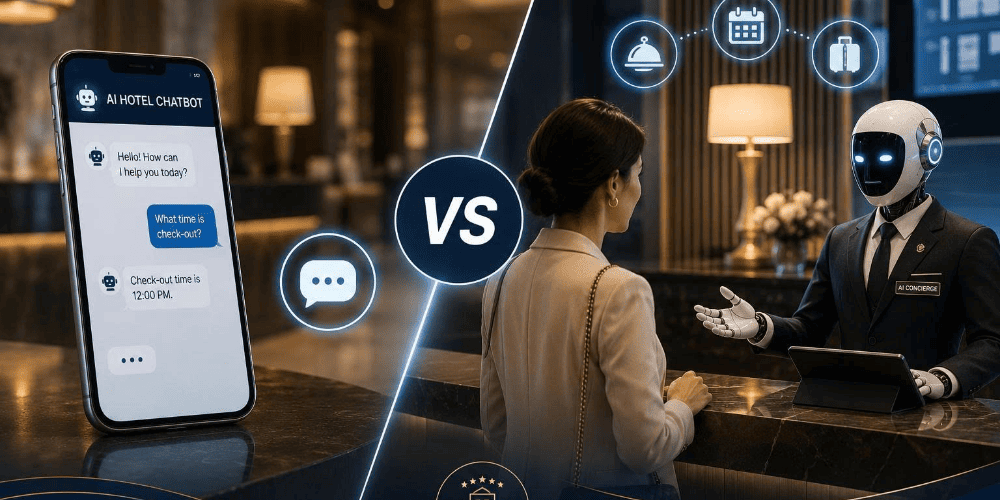
Artificial intelligence is reshaping hospitality by helping hotels deliver faster service, improve operational efficiency, and create more personalized guest experiences. As the adoption of AI in hotel industry continues to grow, two solutions have become increasingly common: AI hotel chatbots and AI concierge assistants. While both use AI to communicate with guests, they are designed for very different purposes.
A hotel chatbot focuses on answering routine questions and automating basic guest interactions, whereas an AI concierge goes beyond conversation to understand guest intent, connect with hotel systems, and complete requests from start to finish. Understanding these differences is essential for hotels looking to choose the right AI solution, improve service quality, and maximize the return on their technology investment.
What Is an AI Hotel Chatbot?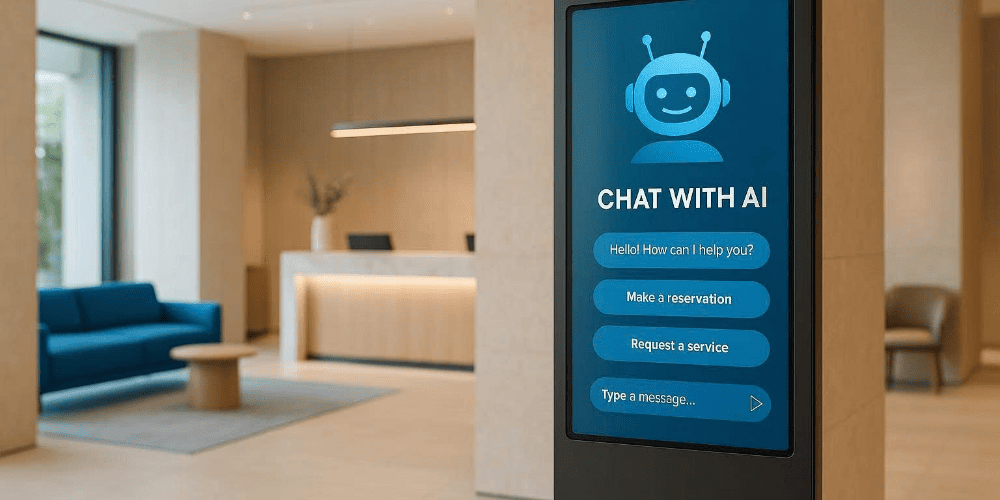
An AI hotel chatbot is a conversational assistant that communicates with guests through websites, mobile apps, booking engines, or messaging platforms. Its primary role is to automate routine conversations, answer frequently asked questions, and provide instant support without requiring direct assistance from hotel staff.
Modern chatbots use natural language processing (NLP) to understand guest questions more naturally than traditional rule-based systems. As a result, they help hotels improve response times, reduce repetitive workloads, and provide 24/7 customer support.
What Can an AI Hotel Chatbot Do?
Common capabilities include:
- Answering frequently asked questions about hotel services.
- Assisting guests during the booking process.
- Providing reservation status and booking confirmations.
- Sharing information about hotel facilities and amenities.
- Offering multilingual customer support.
While these capabilities improve operational efficiency, hotel chatbots are primarily designed to provide information rather than complete complex guest requests.
What Is an AI Concierge?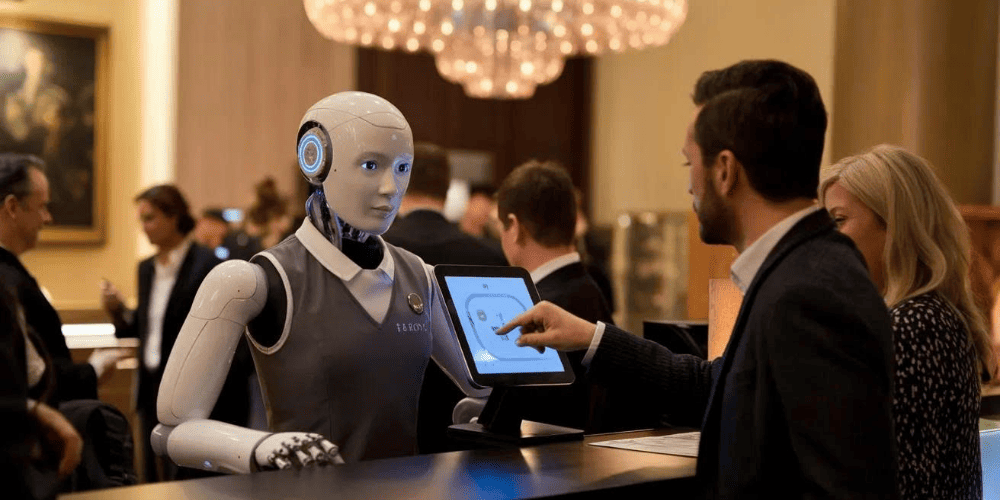
An AI concierge is a more advanced hospitality assistant that not only communicates with guests but also understands their intent, connects with hotel systems, and completes requests throughout the guest journey. Instead of simply answering questions, it can coordinate services and automate operational workflows.
By integrating with systems such as PMS, CRM, booking engines, and POS platforms, an AI concierge accesses real-time hotel data to deliver highly personalized experiences and resolve requests with minimal staff involvement.
What Can an AI Concierge Do?
Depending on its integrations, an AI concierge can:
- Modify reservations.
- Recommend room upgrades.
- Arrange airport transportation.
- Book restaurant reservations.
- Schedule spa appointments.
- Coordinate housekeeping requests.
- Recommend local attractions.
- Personalize offers based on guest history.
Unlike traditional chatbots, an AI concierge can manage complete guest requests, creating a more seamless and personalized experience from check-in to post-stay engagement.
Comparison Table
Although AI hotel chatbots and AI concierge assistants both improve guest communication, they solve different business challenges.
Hotel chatbots primarily automate routine conversations and reduce staff workload by answering frequently asked questions. AI concierge assistants go much further by understanding guest intent, accessing operational systems, and completing requests from beginning to end. The following comparison highlights the key differences between the two solutions.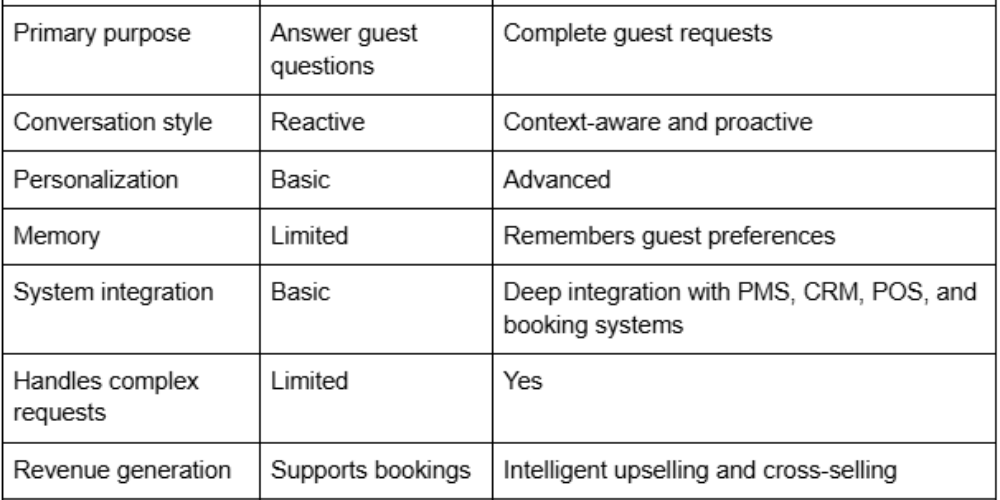
Comparison table of AI hotel chatbots vs AI concierge solutions across features and capabilities.( Source: Internet )
AI Hotel Chatbots vs AI Concierge
Guest Interaction
At first glance, both technologies appear to perform the same task—they communicate with guests through natural conversations. However, the quality of those interactions differs significantly. While AI hotel chatbots focus on answering questions as quickly as possible, AI concierge assistants are designed to guide guests through an entire service experience.
AI Hotel Chatbots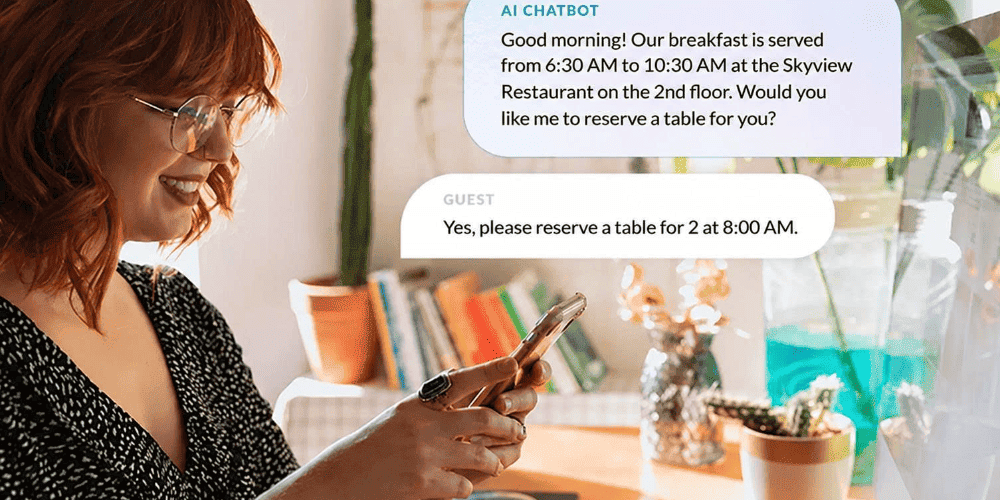
AI hotel chatbot helping a guest book a restaurant table via mobile chat.( Source: Internet )
Hotel chatbots are designed to answer individual questions efficiently and consistently. They work best when guests need quick information rather than personalized assistance or complex service coordination.
Typical interactions include:
- Room availability: Provides instant updates on available room types and pricing, helping guests make booking decisions more quickly.
- Check-in and check-out times: Answers common questions about arrival and departure policies, reducing repetitive inquiries to the front desk.
- Breakfast hours: Shares restaurant schedules, dining locations, and other essential information that guests frequently request.
- Parking information: Explains parking availability, fees, and access instructions, allowing guests to plan their arrival more easily.
- Booking confirmations: Verifies reservation details and confirms booking status, giving guests immediate reassurance without staff assistance.
These conversations are generally short and transactional. Once the guest receives the requested information, the interaction typically ends. This approach works well for frequently asked questions because it provides instant answers while reducing the workload of front desk staff. However, it offers limited support when conversations become more complex or require coordination across multiple hotel services.
AI Concierge
AI concierge helping a hotel guest with personalized service and recommendations.( Source: Internet )
An AI concierge approaches guest communication from a completely different perspective. Instead of simply answering isolated questions, it understands the purpose behind the guest’s request and determines how to complete it using available hotel services and operational data.
For example, if a guest asks about celebrating an anniversary, the AI concierge may automatically recommend:
- A room upgrade: Suggests premium room options that match the occasion while creating opportunities for additional revenue.
- Romantic dinner packages: Recommends curated dining experiences based on the guest’s celebration and restaurant availability.
- Spa treatments: Offers wellness packages or couples’ spa experiences that complement the guest’s itinerary.
- Late check-out: Checks availability and proposes extended checkout times to provide a more relaxed and convenient stay.
- Complimentary welcome amenities: Arranges thoughtful touches such as flowers, chocolates, or welcome drinks to make the occasion more memorable.
Rather than simply providing information, the AI concierge helps organize the entire experience around the guest’s needs. This creates a more personalized journey while improving guest satisfaction and generating additional revenue opportunities for the hotel.
Personalization
Modern travelers increasingly expect hotels to recognize their preferences and tailor every interaction accordingly. Personalization has therefore become one of the defining capabilities of AI in hotel industry solutions. The ability to understand each guest beyond a single booking often determines whether an AI solution feels helpful or genuinely intelligent.
AI Hotel Chatbots
Most hotel chatbots personalize conversations using only the information available during the current interaction. They may greet guests by name, display booking details, answer reservation-specific questions, and provide general recommendations. While these features improve convenience, the level of personalization remains relatively basic because the chatbot rarely understands a guest’s long-term preferences or travel history.
These features help create a smoother booking experience, but the recommendations are often generic. Two guests with completely different travel purposes may still receive similar suggestions because the chatbot has limited context about their individual preferences.
AI Concierge
An AI concierge continuously builds a richer understanding of every guest by combining information from multiple systems. Instead of relying only on the current conversation, it analyzes historical data to deliver recommendations that are more relevant and personalized.
It can personalize recommendations using:
- Previous stays: Reviews past reservations and service usage to identify recurring preferences, enabling more consistent and tailored recommendations.
- Loyalty membership: Recognizes membership status to offer exclusive benefits, personalized upgrades, and rewards that strengthen guest loyalty.
- Room preferences: Remembers preferred room types, bedding options, floor levels, or special requests to provide a more comfortable stay.
- Dining history: Learns guests’ favorite restaurants, cuisines, or dietary preferences, allowing it to suggest dining experiences that better match their tastes.
- Travel purpose: Identifies whether guests are traveling for business, leisure, or special occasions so recommendations align with the purpose of their trip.
- Spending behavior: Analyzes previous purchasing patterns to recommend services and packages that fit the guest’s interests and budget.
- Previous conversations: Retains conversational context from earlier interactions, allowing guests to continue requests naturally without repeating the same information.
As the AI learns from every interaction, its recommendations become increasingly accurate over time. Business travelers, families, and leisure guests can all receive different suggestions based on their unique needs, creating a more natural experience that strengthens guest loyalty and encourages repeat visits.
Handling Complex Requests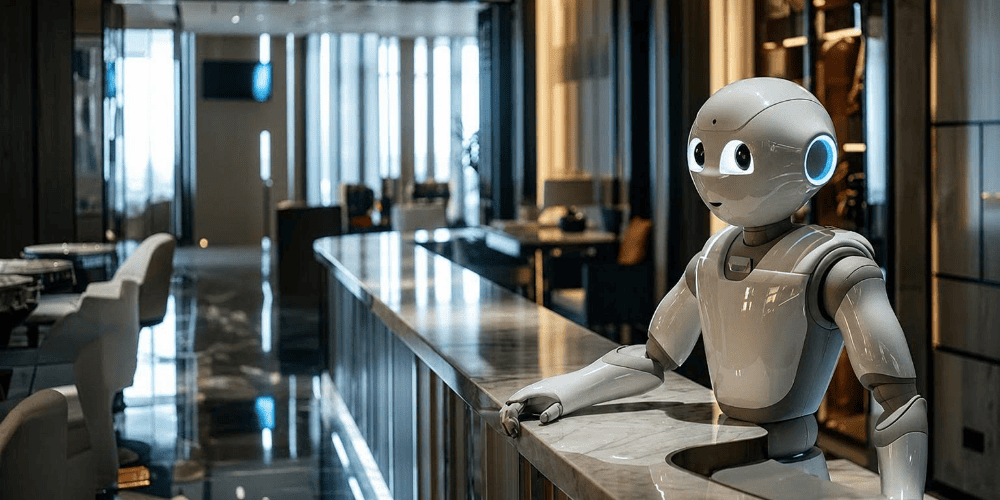
AI hotel concierge handling complex guest requests across multiple hotel services.( Source: Internet )
Guest requests are rarely limited to a single question. During one conversation, a traveler may need to modify a reservation, arrange airport transportation, book a restaurant, request early check-in, and ask about local attractions. The ability to manage these interconnected requests is one of the biggest differences between AI hotel chatbots and AI concierge assistants.
AI Hotel Chatbots
Hotel chatbots perform well when each request can be handled independently. They are designed to provide information quickly and accurately, but they often struggle when conversations involve multiple services or require coordination across departments. In practice, this means they are best suited for straightforward questions rather than complex guest journeys.
For example, a chatbot may be able to explain the hotel’s early check-in policy, share restaurant opening hours, provide a link to airport transfer services, and confirm an existing reservation. Although the guest receives useful information, completing each request usually requires separate conversations or assistance from hotel staff.
Although the guest receives useful information, completing each request usually requires separate conversations or assistance from hotel staff. In this sense, the chatbot functions primarily as an information provider rather than an operational assistant that can actively resolve the request.
AI Concierge
AI concierge assistants are designed to manage complete workflows instead of isolated interactions. Because they understand context and connect with operational systems, they can coordinate several services within one continuous conversation and reduce the need for manual follow-up.
Imagine a guest sends the following message:
“My flight arrives at 9 AM instead of noon. Can I check in early? I’d also like to reserve a table for dinner tonight and arrange airport transportation.”
Rather than answering each question individually, the AI concierge can automatically:
- Check room availability for early check-in.
- Schedule airport pickup based on the updated arrival time.
- Reserve a table at the hotel’s restaurant.
- Notify housekeeping to prioritize room preparation.
- Send a single confirmation summarizing every request.
This creates a seamless guest experience while significantly reducing manual coordination for hotel staff. Instead of switching between departments or repeating the same information multiple times, guests interact with one intelligent assistant capable of managing the entire request from beginning to end.
Integration with Hotel Systems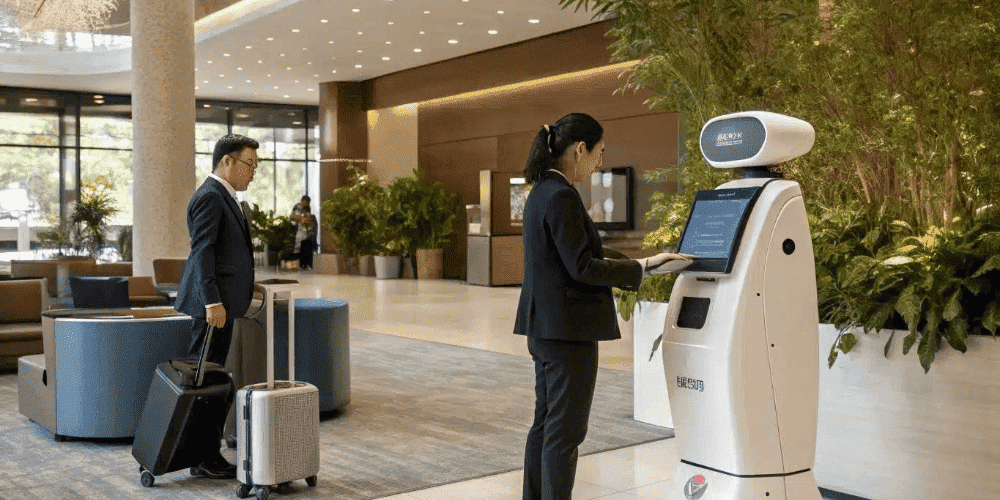
AI hotel concierge integrated with hotel systems to manage guest requests and operations.( Source: Internet )
The intelligence of an AI solution depends not only on how well it communicates but also on how well it connects with the hotel’s operational systems. Without system integrations, even the most advanced conversational AI can only provide general information. It cannot access live room availability, modify reservations, process guest requests, or retrieve customer history. This limitation is why many traditional chatbots stop at answering questions rather than completing tasks.
AI Hotel Chatbots
Many hotel chatbots operate independently from the hotel’s core systems. While they may integrate with basic booking forms or FAQs, their access to operational data is often limited, which restricts what they can actually do for guests.
As a result, many hotel chatbots simply display static hotel information, redirect guests to booking pages, forward complex requests to hotel staff, and require manual follow-up for reservation changes. Although this approach reduces inquiry volume, employees are still responsible for completing most operational tasks.
Although this approach reduces inquiry volume, employees are still responsible for completing most operational tasks. The chatbot helps filter and organize requests, but it does not fully automate the underlying workflow.
AI Concierge
AI concierge assistants are designed to become part of the hotel’s digital ecosystem. By integrating with multiple business platforms, they gain access to the real-time information needed to perform meaningful actions rather than simply providing instructions or generic responses.
Depending on the hotel’s technology stack, an AI concierge can connect with:
- Property Management Systems (PMS) to access reservations, room availability, and guest profiles.
- Customer Relationship Management (CRM) platforms to personalize interactions using guest history and preferences.
- Booking engines to create, modify, or cancel reservations.
- Point-of-Sale (POS) systems to manage restaurant, spa, and other on-property services.
- Loyalty platforms to recognize returning guests and recommend exclusive offers.
These integrations transform AI from a conversational interface into an intelligent operational assistant that can support both guest services and hotel staff. Instead of simply responding to questions, the system can take action, update records, and coordinate services across departments in real time.
Upselling and Revenue Generation
AI hotel concierge driving upselling and revenue growth through personalized guest recommendations. ( Source: Internet )
Artificial intelligence is no longer used solely to improve customer service. It is also becoming an important tool for increasing hotel revenue by identifying relevant opportunities at the right moment in the guest journey.
Both AI hotel chatbots and AI concierge assistants can recommend additional services, but the quality of those recommendations differs significantly. The difference lies in how much context the system can understand and how personalized the offer can be.
AI Hotel Chatbots
Most chatbots support basic upselling through predefined offers presented during the booking process. These offers are usually simple, consistent, and easy to deploy, which makes them useful for hotels that want a quick way to promote add-ons.
Typical chatbot upselling examples include suggesting breakfast packages, offering airport transportation, promoting spa discounts, and recommending room upgrades. Because these offers are often rule-based, every guest receives similar recommendations regardless of travel purpose or personal preferences.
Because these offers are often rule-based, every guest receives similar recommendations regardless of travel purpose or personal preferences. While this approach can generate additional revenue, it rarely delivers highly personalized guest experiences or adapts to the specific context of each stay.
AI Concierge
AI concierge assistants use guest data and contextual understanding to recommend services that are genuinely relevant. Instead of displaying generic upgrade options, the AI analyzes factors such as:
- Previous booking history: Reviews past stays to identify recurring preferences, such as favorite room types or frequently used services, allowing the AI to make more relevant recommendations.
- Length of stay: Considers how long guests are staying to recommend appropriate services, from airport transfers for short visits to spa packages or dining experiences for extended stays.
- Travel purpose: Recognizes whether guests are traveling for business, leisure, or special occasions, enabling recommendations that better fit the purpose of their trip.
- Loyalty membership: Identifies returning guests and loyalty members to provide exclusive offers, personalized upgrades, or member-specific benefits.
- Guest preferences: Learns individual preferences over time, including dining choices, room features, and preferred amenities, creating a more personalized guest experience.
- Seasonal promotions: Matches recommendations with current hotel promotions and seasonal packages, helping guests discover relevant offers while increasing revenue opportunities.
For example, if a returning guest is celebrating an anniversary, the AI concierge might recommend an ocean-view suite, a romantic dinner package, and late checkout. A business traveler, on the other hand, could receive recommendations for executive lounges, airport transfers, and meeting room reservations.
Because these suggestions are tailored to individual needs, guests are more likely to perceive them as valuable recommendations rather than sales promotions. For hotels, this creates opportunities to increase average booking value, improve ancillary revenue, and strengthen long-term guest relationships.
How to Choose the Right AI Solution for Your Hotel
Choosing between an AI hotel chatbot and an AI concierge is not simply a technology decision. It depends on your hotel’s operational complexity, guest expectations, available resources, and long-term digital transformation strategy. The right solution should match both your current needs and your future growth plans.
If your primary objective is to automate repetitive guest inquiries, reduce front desk workload, and provide instant responses around the clock, an AI hotel chatbot can deliver meaningful improvements with relatively low implementation costs. It is often a practical first step for hotels that want to introduce automation without changing too much of their existing workflow.
However, hotels that aim to create highly personalized guest experiences and automate operational workflows may benefit more from an AI concierge. This type of solution is better suited for properties that want to go beyond simple Q&A and build a more connected, service-oriented digital experience.
When evaluating different AI solutions, consider the following questions:
- Does the AI connect directly with your PMS and booking systems?
- Can it complete guest requests instead of only answering questions?
- Does it remember guest preferences across multiple stays?
- Can it coordinate services between different hotel departments?
- Does it provide personalized recommendations based on guest behavior?
- Can it support multiple languages for international travelers?
The answers to these questions often reveal whether a solution is simply a chatbot or a true AI concierge capable of supporting modern hotel operations. Rather than viewing the two technologies as competitors, hotels should consider where they are in their digital transformation journey. Smaller properties with limited operational complexity may find that a chatbot meets their immediate needs, while larger hotels, resorts, and hospitality groups often gain greater value from an AI concierge that integrates deeply with existing systems and delivers a more connected guest experience.
Conclusion
AI hotel chatbots and AI concierge assistants both play an important role in modern hospitality, but they serve different purposes. Chatbots are ideal for handling routine questions quickly, while AI concierge solutions go further by managing requests, connecting with hotel systems, and delivering more personalized guest experiences.
For hotels looking to improve efficiency and guest satisfaction, the best choice depends on their operational needs and long-term goals. A chatbot can be a strong starting point, but an AI concierge offers a more complete solution for hotels that want to automate more of the guest journey and create a truly connected experience.
Readmore: 5 Applications of AI Transforming Hospitality and Their Core Benefits