
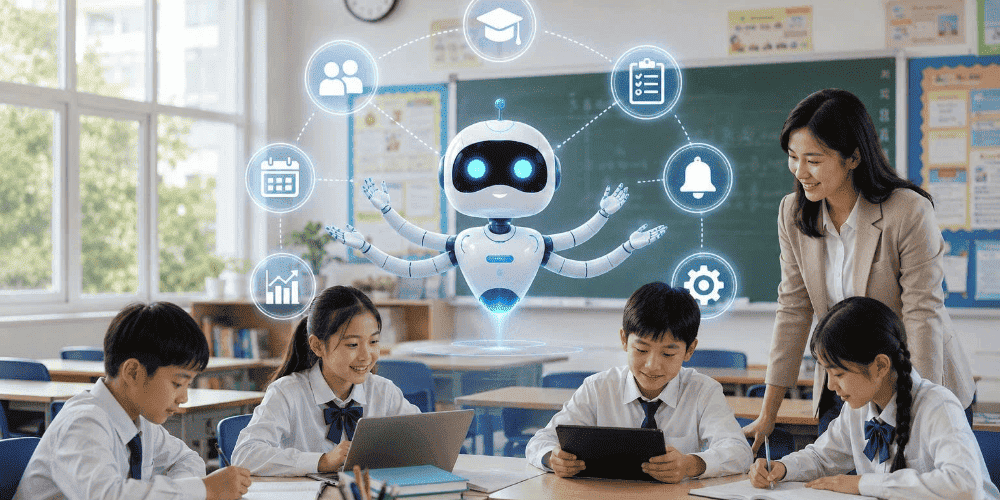
Educational institutions today must manage far more than teaching and learning. Admissions, scheduling, finance, communication, staffing, and campus resources all require constant coordination, and manual processes often struggle to keep up.
AI in education is helping schools improve these operational activities by automating routine tasks, organizing data, and supporting faster decision-making. As a result, administrators can reduce administrative burdens while gaining better visibility into how the institution is performing.
What Is AI in Educational Operations?
AI in educational operations refers to the use of artificial intelligence to improve the administrative and operational processes that support the day-to-day functioning of educational institutions. Unlike instructional AI, which focuses on teaching and learning, operational AI is designed to streamline internal workflows, reduce manual effort, improve operational accuracy, and support faster, more informed decision-making.
At its core, operational AI combines technologies such as machine learning, data analytics, natural language processing, and intelligent automation to process large volumes of institutional data. By analyzing both historical and real-time information, it identifies patterns, detects inefficiencies, and provides actionable insights that help administrators make proactive decisions. Rather than replacing existing school management systems or administrative staff, AI enhances institutional operations by connecting data across departments, automating repetitive tasks, and improving visibility into overall organizational performance. As AI in education continues to evolve, these operational capabilities are becoming increasingly important for schools seeking greater efficiency and long-term sustainability.
Why Schools Need Operational AI
Educational institutions today face growing pressure to deliver high-quality services while managing increasing administrative complexity. As enrollment expands and stakeholder expectations continue to rise, traditional management methods often struggle to keep pace. Many schools still rely on spreadsheets, disconnected software platforms, paper-based records, and manual reporting processes, making it difficult to maintain efficiency across multiple departments.
These outdated workflows often create challenges such as:
- Longer administrative processing times
- Scheduling conflicts
- Delayed communication with parents
- Limited visibility into institutional performance
- Difficulty forecasting enrollment and staffing needs
- Inconsistent financial reporting
- Inefficient resource allocation
Beyond slowing daily operations, these issues can also affect the experience of students, parents, teachers, and administrative staff. Delays in admissions, inaccurate schedules, or poor communication may reduce satisfaction and increase operational costs. As part of the broader adoption of AI in education, institutions are moving beyond reactive management by using real-time operational insights to identify potential problems early, optimize resources more effectively, and make informed decisions based on reliable data rather than assumptions.
5 Ways AI Improves Educational Operations
Intelligent Student Enrollment Management
School administrator using an AI-powered dashboard to manage student enrollment, applications, and admissions efficiently. (Source: Internet)
Student admissions are among the most time-consuming administrative processes in education. During enrollment periods, admissions teams must review applications, verify supporting documents, communicate with applicants, and monitor the progress of hundreds or even thousands of submissions. As application volumes increase, manual processes become slower, more prone to errors, and more difficult to manage efficiently.
AI simplifies this process by automating repetitive administrative tasks while providing greater visibility throughout the admissions cycle. Intelligent systems can categorize applications, identify missing documents, verify submitted information, and update application statuses automatically. Some AI solutions can also prioritize applications based on predefined criteria, helping admissions staff focus their attention where it is needed most.
Key improvements include:
- Faster application reviews
AI automatically organizes and prioritizes applications, allowing admissions teams to review submissions more quickly and reduce processing delays. - Automated document verification
The system identifies missing or incomplete documents, helping ensure applications meet admission requirements before manual review. - Real-time status tracking
Applicants and administrators can monitor admission progress instantly, improving transparency throughout the enrollment process. - Enrollment forecasting
By analyzing historical admission patterns, AI helps schools anticipate future enrollment volumes and plan resources more effectively.
As one of the most practical applications of AI in education, these capabilities help institutions prepare classroom capacity, staffing levels, and recruitment strategies well before enrollment deadlines.
Automated Academic Scheduling
AI-powered academic scheduling dashboard for schools (Source: Internet)
Creating an academic timetable requires balancing classrooms, teachers, student enrollment, course requirements, and institutional policies. Even a small change such as a teacher’s absence or an increase in student enrollment can require extensive manual adjustments that consume valuable administrative time.
AI-powered scheduling systems evaluate thousands of possible scheduling combinations within minutes, identifying solutions that minimize conflicts while maximizing available resources. Instead of manually revising timetables, administrators can quickly generate optimized schedules that accommodate changing requirements with far less effort.
AI scheduling helps reduce:
- Scheduling conflicts: AI identifies potential clashes between classrooms, teachers, and student groups before schedules are finalized.
- Manual adjustments: When changes occur, the system can automatically generate updated schedules with minimal human intervention.
- Administrative workload: Automating timetable creation allows administrators to focus on planning and coordination instead of repetitive scheduling tasks.
- Underutilized classroom space: AI optimizes room assignments to improve facility usage and reduce wasted capacity throughout the campus.
By continuously analyzing scheduling data, AI also helps schools maintain a better balance between teacher workloads, classroom utilization, and student learning needs. This results in more efficient operations while creating a smoother academic experience across the institution.
AI-Powered Tuition and Financial Operations
AI-powered financial management platform (Source: Internet)
Financial administration plays a critical role in the long-term sustainability of any educational institution. Schools must monitor tuition payments, manage outstanding balances, prepare financial reports, and forecast future revenue while ensuring accuracy across every transaction. Performing these tasks manually often requires considerable administrative effort and may delay financial decision-making.
AI streamlines financial operations by automating payment tracking, generating real-time financial reports, and sending personalized tuition reminders when payments become due. Rather than waiting until the end of each reporting period, administrators can monitor financial performance continuously and respond more quickly to emerging issues.
Schools can use AI to:
- Monitor outstanding balances: AI continuously tracks unpaid tuition and highlights overdue accounts that require follow-up.
- Forecast tuition revenue: Predictive analytics estimate future income based on enrollment trends and historical payment behavior.
- Identify payment trends: The system analyzes payment patterns to uncover recurring issues and opportunities for improving collection rates.
- Support budget planning: More accurate financial forecasts help administrators allocate resources and prepare budgets with greater confidence.
These capabilities demonstrate how AI in education can strengthen financial planning while reducing administrative workloads across educational institutions.
Smarter Parent Communication
AI-powered parent support assistant (Source: Internet)
Effective communication between schools and families is essential for building trust and supporting student success. Parents expect timely information regarding admissions, attendance, tuition payments, academic updates, school events, and emergency announcements. Responding to every inquiry manually can quickly overwhelm administrative staff, particularly during busy enrollment periods.
AI-powered communication platforms automate many routine interactions while maintaining consistent and personalized communication. Virtual assistants and intelligent chatbots can answer frequently asked questions, guide parents through enrollment procedures, provide tuition information, and send automatic notifications based on each student’s individual records.
AI-powered communication helps schools provide:
- Faster responses: Chatbots and virtual assistants answer common questions immediately, reducing waiting times for parents.
- Consistent communication: Automated messaging ensures families receive accurate information through standardized communication workflows.
- Multilingual support: AI can communicate in multiple languages, making school information more accessible to diverse communities.
- Reduced call volume for administrative staff: By handling routine inquiries automatically, AI allows staff to concentrate on more complex requests.
Because many AI communication tools operate around the clock, parents receive immediate assistance even outside regular office hours. Administrative teams can therefore focus on more complex requests while maintaining a higher level of service for families.
Resource and Staff Management
AI helps schools optimize resource and staff allocation (Source: Internet)
Managing classrooms, facilities, teaching resources, and staff workloads becomes increasingly challenging as educational institutions grow. Without accurate operational data, schools may experience overcrowded classrooms, underutilized facilities, uneven teacher workloads, or inefficient allocation of available resources.
AI helps administrators gain a comprehensive view of institutional resource usage by continuously analyzing operational data across departments. Instead of relying on periodic reports, decision-makers receive real-time insights into how facilities, classrooms, and staff are being utilized throughout the academic year.
For example, AI can identify:
- Overcrowded classrooms: AI detects spaces operating beyond capacity, helping administrators rebalance student distribution.
- Underused facilities: Usage data highlights classrooms or resources that are not being fully utilized throughout the academic year.
- Workload imbalances across departments: AI compares staffing and teaching loads to support fairer resource allocation among departments.
- Future staffing requirements: Predictive analysis helps schools anticipate hiring needs based on enrollment growth and operational trends.
These insights allow institutions to optimize resource allocation, improve long-term planning, and delay unnecessary infrastructure investments. By making better use of existing resources, schools can increase operational efficiency while creating a more effective learning environment for students and educators.
Best Practices for Implementing AI
Successfully implementing AI requires more than purchasing new software. Educational institutions should approach AI as part of a broader digital transformation strategy with clearly defined objectives, reliable data, and ongoing evaluation. A thoughtful implementation plan helps maximize the benefits of AI while minimizing disruption to existing operations.
Start with Clearly Defined Goals
Rather than deploying AI across every department simultaneously, schools should first identify the administrative processes that create the greatest operational burden. Beginning with high-impact areas such as admissions, scheduling, or financial management allows institutions to achieve measurable improvements before expanding AI to additional functions. Clearly defined objectives also make it easier to measure success and demonstrate the value of AI investments over time.
Ensure High-Quality Institutional Data
AI systems perform best when they have access to accurate, complete, and well-organized information. Schools should review existing databases, remove duplicate records, and establish standardized data management practices before implementing AI solutions. Better data quality leads directly to more reliable AI recommendations.
Integrate AI with Existing Systems
AI integrates seamlessly with existing school management systems (Source: Internet)
AI delivers greater value when it works seamlessly alongside student information systems, finance platforms, learning management systems, and communication tools. Strong integration reduces duplicate data entry, improves collaboration between departments, and ensures consistent information across the institution.
Train Administrative Staff
Technology adoption depends as much on people as it does on software. Administrative teams should receive practical training on how AI supports daily workflows, how to interpret AI-generated insights, and when human judgment remains essential. Building confidence among staff encourages successful long-term adoption.
Establish Strong Data Security and Governance
Educational institutions manage sensitive information about students, parents, employees, and finances. Schools should establish clear governance policies, access controls, and cybersecurity measures to protect institutional data while ensuring compliance with relevant privacy regulations.
Monitor Performance and Improve Continuously
AI implementation should be viewed as an ongoing process rather than a one-time project. Institutions should regularly measure operational performance, collect user feedback, and refine AI workflows to ensure the technology continues delivering measurable improvements as organizational needs evolve.
The Future of AI in Educational Operations
AI in education will continue to evolve from basic automation into intelligent operational support. Future systems will help schools predict enrollment demand, optimize staffing, manage campus resources, and coordinate administrative workflows more proactively. As AI technologies become more sophisticated, educational institutions will be able to make faster, data-driven decisions while improving operational efficiency across multiple departments.
While human leadership will remain essential, AI will increasingly provide the insights and automation needed to manage educational institutions more efficiently. Rather than replacing administrators, AI will serve as a decision-support tool that enables staff to focus on strategic planning, student services, and continuous institutional improvement.
Conclusion
AI in education is improving educational operations beyond the classroom by helping schools streamline admissions, scheduling, finance, communication, and resource management. By reducing manual work and providing real-time operational insights, AI enables administrators to make faster and more informed decisions while creating more efficient workflows across the institution.
As educational institutions continue to grow and adapt to changing demands, operational AI will become an increasingly valuable tool for building more efficient, responsive, and future-ready school management systems. Schools that adopt AI strategically, supported by high-quality data and well-defined implementation plans, will be better positioned to improve operational performance and deliver a better experience for students, parents, teachers, and administrative staff.
Lifesup AI empowers educational institutions with intelligent AI solutions for admissions, scheduling, finance, communication, and operational management. Contact our team today to explore a solution tailored to your school’s needs.
>>Read more: AI Solution for Personalized Learning and Enhanced Educational Outcomes