

From Language Models to Autonomous Agents: The Evolution of Generative AI
The journey of Generative AI began with large language models (LLMs) like GPT, which could understand and generate human-like text. These models revolutionized how we interact with machines – enabling everything from chatbots to content creation.
Now, we’re entering the era of autonomous agents – systems that not only understand language but can plan, act, and adapt to achieve goals independently. These agents are built on top of LLMs but go further: they monitor environments, make decisions, and execute tasks across digital systems.
In manufacturing, this evolution entails transitioning from static automation to dynamic, intelligent systems that optimize operations in real-time.
The core differentiator of Generative AI Agents compared to legacy automation is their Reasoning capability. Instead of following rigid “If-Then” scripts, they operate through a closed-loop system powered by Large Language Models (LLMs):
- Multimodal Perception: Agents do more than just read sensor data. Leveraging “Generative” capabilities, they can interpret visual feeds from defect-detection cameras, analyze machine acoustics to predict failures, or synthesize insights from 100-page engineering PDFs.
- Dynamic Planning: This is where true intelligence begins. The Agent asks: “Given the current machine status, what steps are needed to meet production goals?”. It autonomously decomposes complex objectives into actionable steps: checking inventory -> rerouting backup machinery -> drafting notifications for supervisors.
- Action & Creation: Agents don’t just send control commands; they generate new content to solve problems. This includes drafting new Standard Operating Procedures (SOPs) for the next shift or even rewriting code to patch software glitches on the production line.
Generative AI Agents Are Like Google Maps for Your Factory
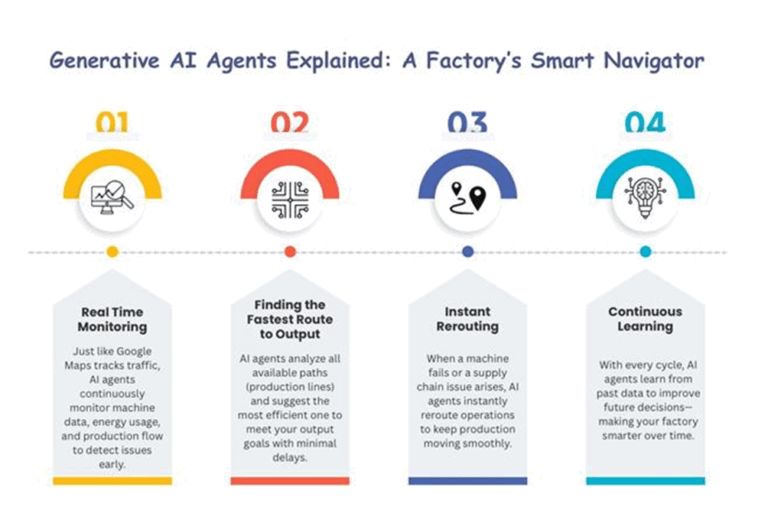
Imagine your factory is a city. You have multiple routes (production lines), traffic (machine breakdowns) and destinations (output goals). A generative AI agent acts like Google Maps:
- It constantly monitors traffic (real-time machine data).
- It suggests the fastest route (optimized workflows).
- It reroutes you instantly if there’s a roadblock (such as a supply chain disruption).
- It learns from every trip to improve future decisions.
Just like you wouldn’t drive without navigation in a new city, AI Agents are vital in seamlessly operating the modern factories.
How Generative AI Agents Enhance Manufacturing Processes
Generative AI agents are not just futuristic concepts – they’re practical tools reshaping how factories operate today. By embedding intelligence into everyday workflows, these agents help manufacturers move from reactive decision-making to proactive, data-driven operations. Below are five key areas of the many where generative AI agents are making a measurable impact.
1. Predictive Maintenance
Moving away from traditional fixed-schedule or reactive maintenance, Generative AI Agents establish a 24/7 intelligent monitoring system. By analyzing real-time sensor data, these agents detect subtle anomalies and accurately predict potential failures before they occur. This shift to a proactive model enables manufacturers to reduce unplanned downtime by up to 50% (according to McKinsey).
2. Generative Design
Moving beyond manual, time-consuming CAD iterations constrained by human experience, Generative AI Agents autonomously produce a wide array of design options based on predefined performance goals, material constraints, and cost targets. This shift not only accelerates the prototyping phase but also delivers optimized designs that significantly minimize material waste.
3. Process Optimization
Moving away from manual adjustments based on historical data and operator intuition, Generative AI Agents continuously monitor production streams in real time. They autonomously suggest immediate parameter adjustments to maximize throughput and minimize energy consumption. This intelligent orchestration leads to a 20–30% improvement in productivity (according to BCG).
4. Supply Chain Resilience
Moving beyond static planning vulnerable to disruptions, Generative AI Agents establish a proactive and agile management system. These agents continuously simulate potential disruptions—such as supplier delays or logistics bottlenecks—to instantly recommend adaptive strategies. This shift significantly enhances operational agility and minimizes risk exposure across the entire value chain.
5. Workforce Augmentation
Moving beyond a reliance on static manuals or supervisor availability for troubleshooting, operators are now empowered by Generative AI Agents. These agents provide real-time guidance, dynamic work instructions, and contextual decision support. This collaboration significantly reduces training time and ensures high operational consistency across the factory floor.
While these five use cases represent some of the most impactful applications of generative AI agents in manufacturing, they are just the beginning. The true power of these agents lies in their flexibility and scalability—they can be custom-built to address unique operational challenges, integrate with existing systems and evolve with your business needs.
Whether it’s energy optimization, real-time compliance monitoring or adaptive workforce scheduling, the possibilities are vast and tailored innovation is well within reach.
>> Read more: Generative AI in Retail: Key Benefits and Real-World Use Cases
Tangible Business Benefits:
The impact of Generative AI Agents extends far beyond technical upgrades, driving breakthrough financial growth. According to McKinsey, Generative AI could slash global operational expenses in manufacturing and supply chains by up to $500 billion. Early adopters are already reaping significant rewards:
- Comprehensive Productivity Gains: A 20–30% boost in productivity by automating repetitive tasks and optimizing real-time operational workflows.
- Operational Cost Savings: Up to a 50% reduction in unplanned downtime, ensuring continuous production flow and minimizing emergency repair costs.
- Accelerated Business Cycles: Significantly faster time-to-market for new products through rapid AI-driven design and prototyping.
- Compliance & Sustainability: Beyond enhancing reporting accuracy, these agents align with global standards. Many platforms now offer pre-configured reporting for ESG, ISO, and GHG protocols, ensuring seamless compliance with environmental and governance regulations.
Limitations and Long-Term Value
Despite their massive potential, the journey to implementing Generative AI Agents involves three core challenges:
- Data Quality & Integration: An agent’s reasoning is only as good as its data. Integrating AI with fragmented legacy systems and ensuring high-quality data streams remains a primary obstacle.
- Change Management: Success depends on human trust. Teams must be reskilled to move from “doing the work” to “collaborating with and supervising” AI.
- Initial Investment: Establishing data architecture and attracting AI talent requires significant upfront capital.
However, these are merely short-term hurdles. As Gartner emphasizes, organizations that invest early in Generative AI Agents will gain more than just immediate efficiency; they will build a foundation for long-term resilience and a sustainable competitive advantage in the new era of manufacturing.
Final Thoughts
Generative AI agents are not just a technological upgrade—they represent a strategic shift in how manufacturing operates. From predictive maintenance to autonomous decision-making, these agents are redefining what’s possible on the factory floor.
“The future of manufacturing is intelligent, adaptive and AI-driven – and it’s already here”
Don’t just adopt AI – orchestrate it with Lifesup AI. Our Generative AI Agents are designed to transform your manufacturing floor into an intelligent, self-optimizing ecosystem. Take the first step toward long-term resilience and operational excellence today.
References: