

Education has always relied on teachers to inspire students, develop critical thinking, and create engaging learning experiences. However, modern teaching now extends far beyond the classroom. Educators are also responsible for lesson planning, grading, preparing materials, communicating with parents, and managing student progress. These tasks often take up a large portion of their time, leaving less room for direct interaction with students.
To address this challenge, schools are increasingly turning to technology. Among the most impactful innovations, AI in education stands out as a powerful tool that helps teachers reduce workload and improve efficiency. Instead of replacing educators, AI supports them by automating repetitive tasks and providing useful insights that enhance teaching quality.
Why Teachers Spend So Much Time Beyond Teaching
When people think about teaching, they often imagine educators standing in front of a classroom delivering lessons. In reality, classroom instruction represents only one part of a teacher’s daily responsibilities. Much of their time is spent on tasks that happen before and after class, many of which are repetitive but essential to ensuring students receive a high-quality education.
One of the biggest reasons teachers feel overloaded is the number of non-teaching tasks they must handle every day. These responsibilities are necessary, but they often take time away from direct student interaction.
- Lesson planning: designing objectives, preparing materials, and aligning content with curriculum standards
- Assessment work: creating quizzes and assignments, then grading and providing feedback
- Administrative duties: attendance tracking, reporting, scheduling, and record management
- Communication tasks: responding to parents, coordinating with colleagues, and attending meetings
Each of these tasks may seem small on its own, but together they create a heavy workload that extends far beyond classroom hours. In many cases, teachers spend evenings and weekends completing work that is not directly related to teaching in the classroom, which contributes to stress and burnout.
As educational expectations continue to rise, teachers are expected to accomplish more within the same number of working hours. Consequently, schools are increasingly looking for technologies that improve operational efficiency without compromising educational quality. This is where AI in education is making a meaningful difference by helping educators automate routine work while allowing them to concentrate on teaching itself.
How AI in Education Helps Teachers Save Time
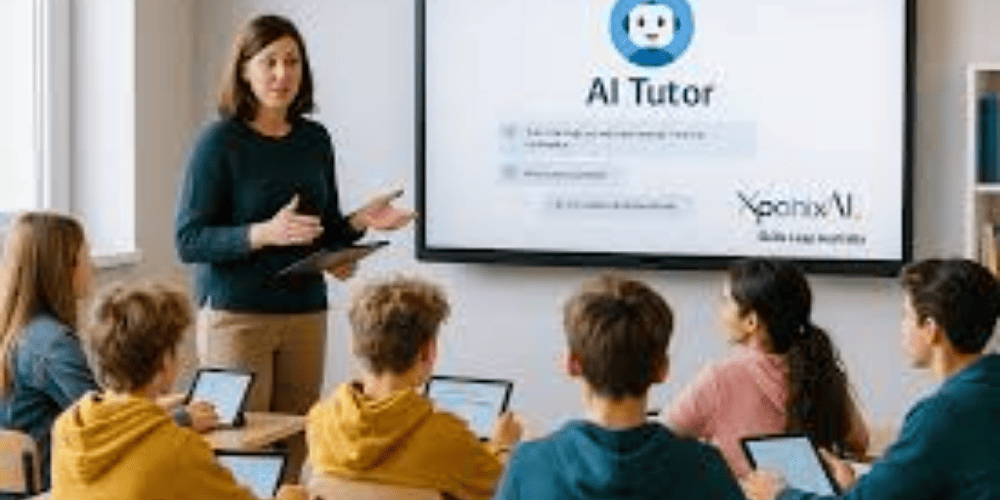
How AI in Education Helps Teachers Save Time and Improve Classroom Efficiency (Source: Internet)
Artificial intelligence is changing the role of educational technology from a simple digital tool into an intelligent teaching assistant. Instead of requiring teachers to complete every administrative task manually, AI in education streamlines repetitive processes, generates instructional resources, and provides actionable insights that support daily teaching activities.
Rather than replacing professional expertise, AI enhances productivity by allowing teachers to spend less time on routine work and more time helping students succeed.
Automating Lesson Planning

Automating Lesson Planning with AI: Helping Teachers Create High-Quality Lessons More Efficiently (Source: Internet)
Creating effective lesson plans requires significant preparation. Teachers must establish learning objectives, organize classroom activities, prepare instructional materials, and ensure that every lesson aligns with curriculum standards. Repeating this process for multiple classes every week can be extremely time-consuming.
With AI in education, lesson planning becomes faster and more efficient. Instead of building everything from scratch, teachers can rely on AI to generate structured drafts in minutes. AI tools can quickly produce complete lesson plan outlines based on the subject, grade level, and learning objectives, giving teachers a strong starting point that already follows curriculum requirements. From there, educators can refine and adjust the content to match their teaching style and classroom context.
AI can also suggest classroom activities, discussion prompts, and project ideas that align with specific learning goals, helping teachers design more engaging lessons without spending hours brainstorming. In addition, it can adapt content for different student ability levels, making differentiated instruction easier to implement in practice.
These capabilities reduce preparation time while still allowing teachers to maintain full control over the final lesson design. As a result, educators spend less time on repetitive planning and more time improving instructional quality and student engagement.
Faster Quiz and Assignment Creation
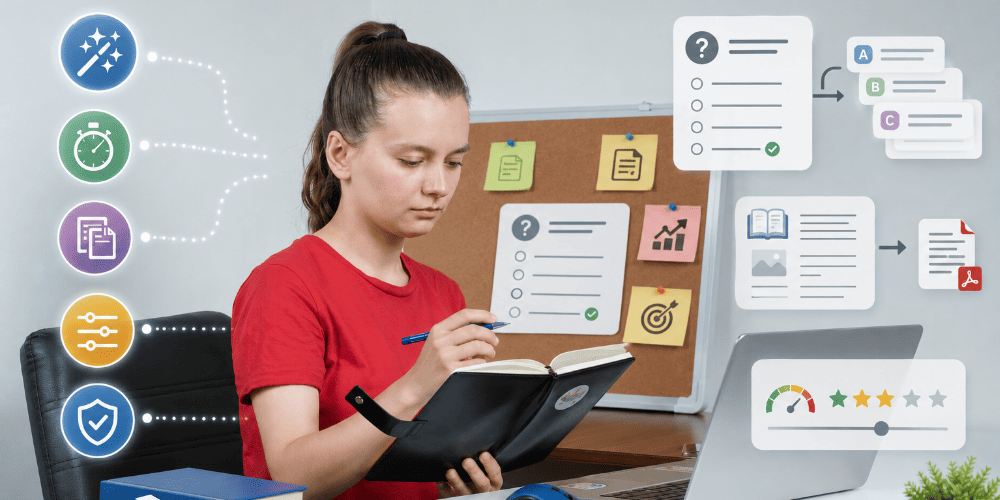
AI-Powered Quiz and Assignment Creation: Helping Teachers Design Assessments in Minutes (Source: Internet)
Developing classroom assessments is another repetitive task that consumes a considerable amount of time. Teachers often need to prepare quizzes, homework assignments, worksheets, and exams while ensuring alignment with learning outcomes.
Artificial intelligence significantly simplifies this process.
- Instant question generation: AI creates multiple-choice, short-answer, and essay questions within seconds.
- Worksheet creation: Teachers can generate reading tasks, comprehension exercises, and practice sheets automatically.
- Multiple test versions: AI produces different versions of the same assessment to reduce answer sharing between students.
- Difficulty customization: Assessments can be adjusted based on difficulty level or learning objectives.
This flexibility helps reduce preparation time and also minimizes the risk of students sharing identical answers across classes. By generating multiple variations of assessments quickly, AI supports fairer evaluation practices while reducing teacher workload. Teachers still review and adjust the content, but the initial workload is greatly reduced, allowing more focus on improving teaching strategies and learning outcomes.
Automated Grading and Feedback
Grading is often one of the most time-consuming responsibilities for teachers, especially in large classrooms. Reviewing assignments, calculating scores, and writing feedback can take hours each week, leaving less time for lesson preparation and student interaction.
This is where AI in education provides major efficiency improvements.
- Automatic grading: AI evaluates quizzes and multiple-choice tests instantly and accurately.
- Performance reports: Teachers receive detailed summaries of individual and class-wide results.
- Error pattern detection: AI identifies common mistakes and learning gaps across students.
- Feedback suggestions: The system generates draft feedback that teachers can edit and personalize.
These features significantly reduce repetitive grading work while also improving consistency in evaluation. Instead of spending time on repetitive scoring tasks, teachers can focus on interpreting results and providing deeper academic guidance.
However, teachers remain essential in evaluating complex assignments that require creativity, reasoning, and subjective judgment. AI simply handles the repetitive parts so educators can focus on deeper academic feedback, ensuring that human expertise remains central to the learning process.
Classroom Administration
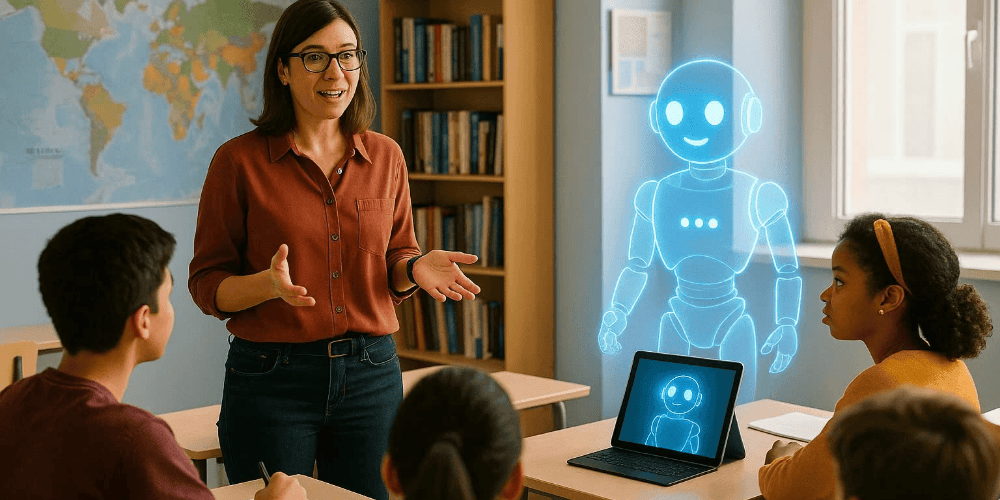
AI-Powered Classroom Administration: Reducing Administrative Workload for Teachers (Source: Internet)
Administrative work is another major source of time pressure for teachers. Tasks such as attendance tracking, scheduling, and record management often take up valuable hours that could be spent on teaching. As schools continue adopting digital technologies, the volume of administrative information also increases, making efficient classroom management more important than ever.
AI helps streamline these responsibilities through automation. By handling routine processes in the background, AI enables teachers to spend less time on operational tasks and more time maintaining an organized, productive learning environment.
- Automated attendance tracking: Digital systems record student attendance quickly and accurately.
- Smart scheduling: AI organizes classes, exams, and school events with minimal conflicts.
- Automated reminders: Homework deadlines, announcements, and updates are sent automatically.
- Centralized data management: All student records are stored in one accessible system.
With these tools, teachers no longer need to switch between multiple systems or manually update records. Everything becomes more organized, faster, and easier to manage, reducing administrative friction and improving overall classroom efficiency.
Personalized Student Support

AI-Powered Personalized Student Support: Helping Educators Meet Every Student’s Learning Needs (Source: Internet)
Every classroom includes students with different learning speeds, strengths, and challenges. Identifying who needs help and when can be difficult, especially in large classes where individual monitoring is limited. Without timely insights, it is often challenging to recognize learning difficulties until they begin affecting overall academic performance.
AI in education helps teachers address this challenge by analyzing student data in real time. Rather than relying solely on periodic assessments, educators gain continuous visibility into learning progress, allowing them to make more informed instructional decisions throughout the school term.
- Early risk detection: AI identifies students who are struggling based on performance trends.
- Engagement tracking: Participation and learning activity are monitored automatically.
- Resource recommendations: AI suggests targeted exercises and learning materials for each student.
- Instructional insights: Teachers receive data-driven suggestions to adjust teaching strategies.
Instead of replacing teacher judgment, AI acts as a support system that highlights important signals. Educators can then combine these insights with their classroom observations and professional experience to determine the most appropriate support for each student.
By combining data analysis with instructional insight, AI helps teachers make better decisions while keeping the focus on human-centered teaching.
How AI Improves Teaching Quality

How AI Improves Teaching Quality by Empowering Educators with Intelligent Teaching Support (Source: Internet)
The greatest value of AI in education is not simply reducing teachers’ workload it is helping educators deliver more effective instruction. By automating repetitive administrative tasks, AI gives teachers more time to focus on activities that directly improve student learning.
More Meaningful Classroom Interaction
With less time spent preparing materials and handling paperwork, teachers can dedicate more attention to classroom discussions, answer students’ questions, and encourage active participation. This creates a more engaging learning environment where students play an active role in the learning process.
Data-Driven Teaching Decisions
AI analyzes assessment results, classroom participation, and learning patterns to provide valuable insights into student performance. These insights help teachers identify learning gaps, monitor progress, and adjust instructional strategies before academic challenges become more difficult to address.
Stronger Personalized Learning
By reducing routine administrative work, AI in education allows teachers to spend more time supporting students who need additional guidance while providing enrichment opportunities for advanced learners. This enables a more personalized learning experience that better meets individual student needs.
Greater Innovation in Teaching
The time saved through AI gives educators more flexibility to develop collaborative projects, problem-based learning activities, interactive lessons, and digital learning experiences. Teachers can focus on fostering critical thinking, creativity, communication, and problem-solving skills that are essential for future success.
AI Supports Teachers, Not Replaces Them
While AI improves efficiency through automation and learning analytics, teachers remain at the center of education. Human judgment, classroom leadership, emotional support, and meaningful teacher-student relationships continue to play an irreplaceable role in successful learning outcomes.
Conclusion
As schools continue embracing digital transformation, AI in education is becoming a valuable tool for improving teaching efficiency and enhancing the overall learning experience. By automating repetitive tasks such as lesson planning, grading, and classroom administration, AI enables teachers to spend more time on student engagement, personalized instruction, and meaningful classroom interactions.
Rather than replacing educators, AI strengthens their ability to teach more effectively. Solutions like Lifesup AI help educational institutions streamline daily operations while keeping teachers at the center of the learning process. By combining intelligent automation with human expertise, schools can create more efficient, engaging, and student-focused learning environments.
>>Read more: AI Solution for Personalized Learning and Enhanced Educational Outcomes