
Why Do Appointment Change Requests Disrupt Clinic Workflows?
A patient may call after hours, reply to a SMS reminder, submit a web form, or request a new time slot directly at the front desk. Each request appears simple at first glance. Difficulty arises when critical patient context sits scattered across disconnected channels or when the next operational owner is unclear. Front desk staff must then spend valuable minutes reconstructing context before completing a basic administrative step.

Disrupted handoffs stem from operating design challenges rather than software limitations. Introducing new technology cannot fix an unclear handoff process unless the care team first agrees on accountability, approved records, transfer signals, and escalation protocols.
For a broader strategic perspective on operational design, explore our full analysis on AI in healthcare for care coordination across departments. This practical checklist focuses specifically on non-clinical administrative appointment changes and does not cover diagnosis, treatment, or clinical triage.
What Are the 5 Pillars of a Clear Administrative Handoff?
A practical appointment change map addresses five fundamental operational questions. Keep this framework concise so frontline staff and clinic managers can review and execute it together.
- Trigger defines the exact entry point of the request such as a phone call, messaging app, web form, or in-person inquiry.
- Approved Context specifies the minimum data needed for the next administrative action using only information the clinic is authorized to store and process.
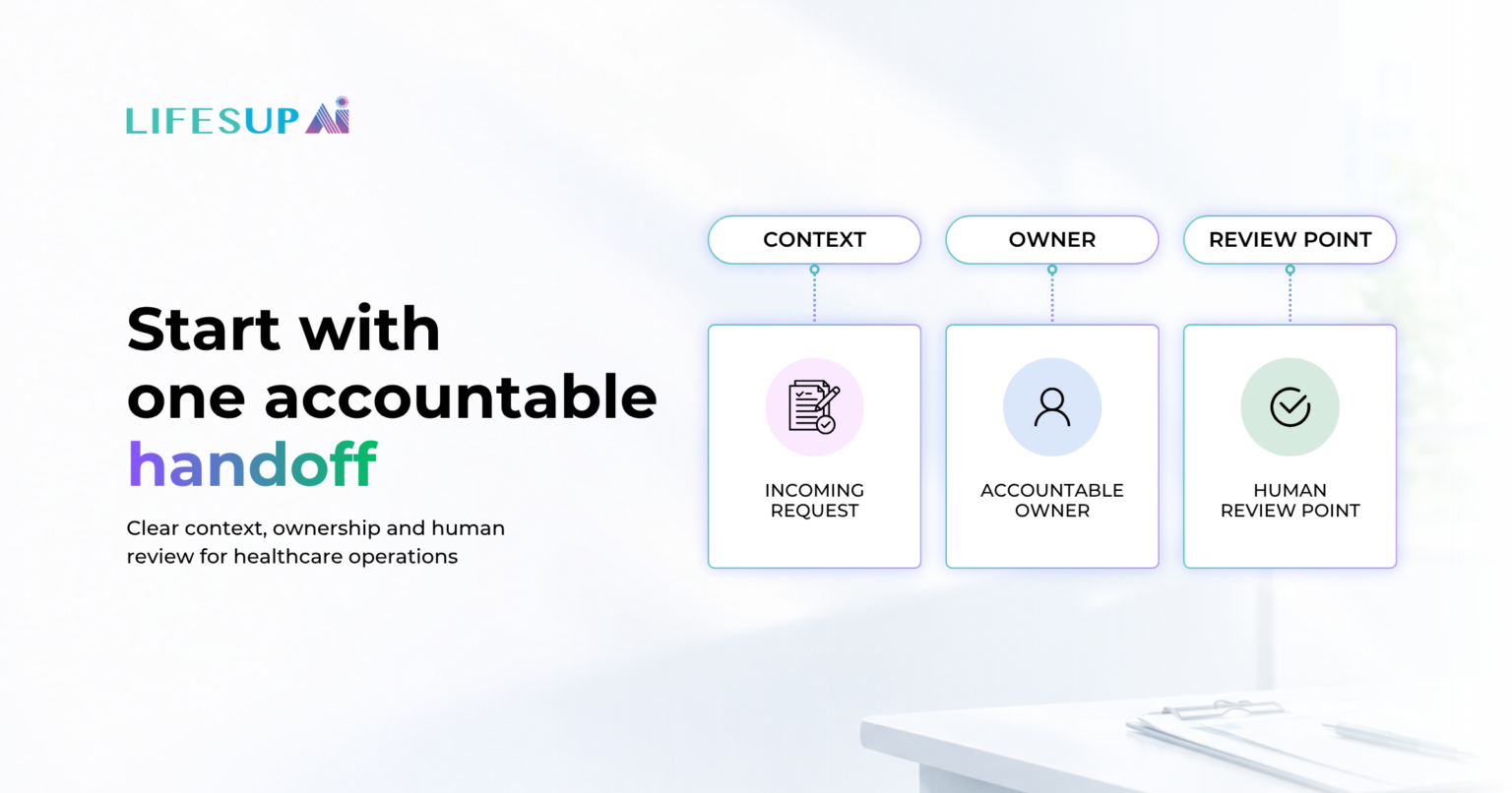
- Accountable Owner designates the specific role responsible for executing the next step such as a front desk coordinator or scheduling specialist rather than a vague department name.
- Transfer Signal provides a visible marker in the central system confirming that responsibility has moved, including an assigned task or updated status.
- Exception Route establishes a clear pathway for requests requiring professional judgement, ensuring clinical questions escalate immediately to qualified staff.
How Can Clinic Teams Map the Handoff Process in 1 Session?
Focus on one common appointment request type instead of attempting to redesign the entire patient journey at once. Bring together front desk coordinators, patient service reps, and scheduling leads for a focused mapping session.
- Document the primary request trigger on the left side of the process map.
- List the exact approved context required to complete the next administrative step.
- Assign a named operational role as the owner for each task.
- Define the system signal that confirms every successful handoff.
- Detail exception criteria along with their dedicated human review routes.
- Identify the authorized system that holds the single source of truth for final records.
The final outcome must reside inside the organization’s official system of record. Private messaging threads, personal notes, or unverified AI conversation logs must never serve as separate sources of operational truth.
How Should Operations Managers Test the Handoff Map?
Select three recently completed appointment change requests and review them alongside the staff members who handled them. Use these real examples as learning aids to refine process clarity.
- Could the team identify the exact owner at every stage of the request?
- Did the receiving staff member obtain sufficient approved context to act immediately?
- Was the transfer of responsibility clearly visible to the rest of the team?
- Did clinical exceptions reach the appropriate qualified professional without delay?
- Was the final confirmed schedule updated inside the official system of record?
If the workflow map fails to explain a past operational delay, identify the missing owner, context gap, or signal failure. Resolve these process gaps before evaluating any form of workflow automation.
Where Does Bounded AI Support Administrative Care Coordination?
Once handoff boundaries are established, healthcare managers can assess where bounded AI capabilities add value. Approved applications include preparing incoming requests for staff review or routing recognized exceptions to specific human queues. Every automated action must align with internal policies, access permissions, and system constraints.
Maintaining strict operational boundaries remains critical. AI must never diagnose conditions, recommend treatments, assess clinical urgency, or replace professional healthcare judgement.
Responsible technology integration requires clear operational boundaries. World Health Organization guidance prioritizes ethics and human rights in healthcare AI, while the NIST AI Risk Management Framework emphasizes explicit human accountability across automated workflows.
Key Metrics for Evaluating Handoff Efficiency
Track operational metrics that reflect process adherence and care coordination consistency. Useful indicators include the following performance measures.
- Percentage of incoming requests with an assigned accountable owner
- Number of unresolved administrative exceptions per week
- Average time elapsed before initial staff action
- Rate of confirmed changes accurately logged in the authorized system
Treat these indicators as assessment tools rather than fixed targets. Establish a clear baseline, monitor performance over a set trial period, and review exception logs before deciding to scale or adjust your process.
Readiness Checklist for Your First Workflow Pilot
Review this checklist before deploying bounded AI tools in your clinic operations.
- One recurring administrative request type has been selected and documented.
- The primary trigger and required context fields are defined.
- Every step in the workflow has an assigned role owner.
- Transfer signals are fully visible within current operational systems.
- Clinical questions have a designated human escalation route.
- The central system of record retains all confirmed final data.
- Permitted AI tasks and prohibited actions are clearly outlined.
- Two or three practical process metrics have been selected for tracking.
- Data privacy, access permissions, and compliance rules have been verified.
If key items on this checklist remain unverified, focus on refining your underlying process design first.
Start Small with One Accountable Workflow
An effective appointment change process does not need to transform the entire clinic overnight. Begin with one high-volume request type, make ownership and exception routes explicit, and validate the workflow alongside your frontline team.

Lifesup AI integrates AI Chatbot, CRM, AI Copilot, and AI Insights into a unified operational flow. Our platform helps healthcare and education teams map clear boundaries, automate routine administrative tasks, and keep qualified staff in complete control of critical decisions.
Ready to structure your administrative handoffs? Contact Lifesup AI to schedule a focused workflow mapping session.