

In today’s hyper-competitive digital landscape, AI advertising is no longer an experimental concept but has become a critical strategy for enhancing marketing performance and driving business growth. By leveraging artificial intelligence, businesses can overcome the limitations of traditional advertising approaches and shift toward data-driven, automated, and highly personalized operations at scale.
This article provides a comprehensive overview of AI advertising through a structured approach covering its benefits, limitations, key applications, and emerging future trends specifically designed for B2B leaders and decision-makers.
What is AI Advertising?
AI advertising refers to the application of artificial intelligence in advertising activities to optimize performance and automate the entire campaign execution process across digital platforms.
Unlike traditional approaches that rely heavily on manual operations and experience-based decisions, AI advertising operates on real-time data and intelligent analytics. As a result, businesses can accurately identify target audiences, deliver ads more effectively, and continuously improve campaign performance. In addition, this technology enables the prediction of customer behavior and demand, allowing brands to take a more proactive approach in their marketing strategies.
With these advantages, AI advertising is rapidly becoming an inevitable trend, contributing to enhanced marketing efficiency and sustainable business growth
Core Components of AI Advertising
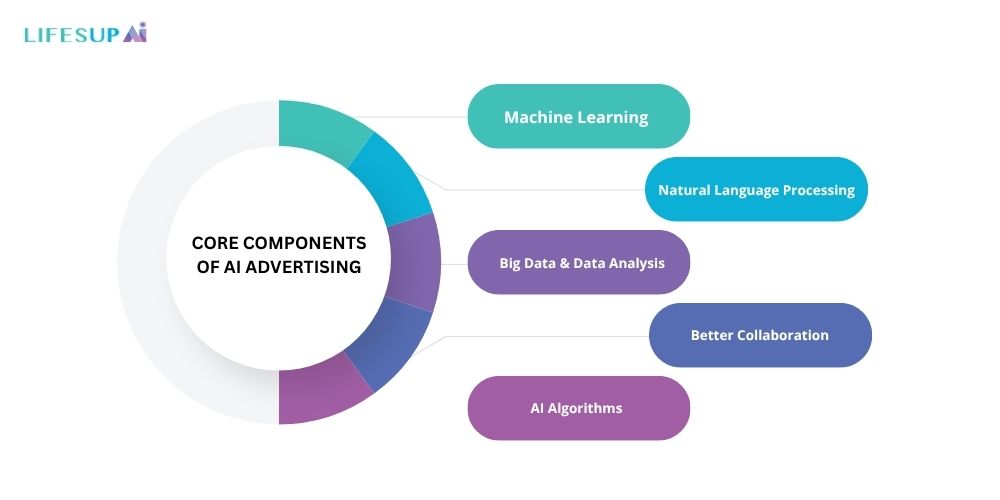
AI advertising is powered by several foundational technologies that work together to deliver efficiency, scalability, and precision.
Machine Learning
Machine learning is the core foundation of AI advertising, enabling systems to learn from data and continuously improve over time. By analyzing both historical and real-time user behavior, machine learning can predict which customers are most likely to convert, estimate their long-term value, and automatically adjust bidding strategies to maximize performance.
As the system processes more data, it becomes increasingly accurate in targeting the right audience, helping businesses run more efficient and effective advertising campaigns.
Natural Language Processing
Natural Language Processing (NLP) enables machines to understand and generate human language, making it a key component in content-driven advertising campaigns. It allows businesses to automatically create ad copy tailored to different audience segments, analyze customer sentiment from feedback and social media, and refine messaging to ensure the right tone and relevance.
In addition, NLP supports conversational marketing experiences such as chatbots, helping brands engage with customers in a more natural and personalized way.
Big Data & Data Analysis
AI advertising relies heavily on large-scale data processing to transform raw information into valuable insights. Data is aggregated from multiple sources such as websites, mobile applications, CRM systems, and social media to:
- Identify behaviors and trends
- Enable real-time analysis
- Build unified customer profiles
As a result, businesses can target the right audience with greater accuracy.
Automation
Automation plays a crucial role in streamlining campaign operations and reducing manual workload. AI can:
- Automatically manage ad placements and media buying
- Conduct large-scale A/B testing
- Generate performance reports automatically
As a result, campaigns can be deployed faster, continuously optimized, and operated more efficiently.
AI Algorithms
AI algorithms act as the decision-making “brain” of advertising systems. They help:
- Determine the optimal timing and placement for ads
- Select the most effective ad creatives for each audience segment
- Detect anomalies or performance issues in real time
Through continuous learning and adaptation, these algorithms ensure that campaigns are consistently optimized to achieve the highest possible ROI.
Key Applications of AI in Advertising
AI advertising is already transforming how businesses plan and execute campaigns across industries.
Data Analytics & Demand Forecasting
AI enables advanced analytics and predictive insights that go far beyond traditional reporting methods. By analyzing historical data alongside external factors, it can forecast market demand, identify peak buying periods and seasonal trends, and help businesses align their advertising strategies with inventory planning.
As a result, companies can make more informed decisions, optimize resources effectively, and minimize missed revenue opportunities.
Creative Content Generation
AI is redefining the content creation process by making it faster, more scalable, and highly efficient – playing a key role in modern AI content marketing strategies. It can automatically generate ad copy, visuals, and even videos, while simultaneously testing multiple creative variations to identify what works best.
By continuously optimizing content based on engagement metrics, AI helps improve performance and significantly reduces the time needed to launch and refine advertising campaigns.
Hyper-Personalization
One of the most powerful capabilities of AI advertising is its ability to deliver personalized experiences at scale. By leveraging user behavior and preferences, AI can tailor ads to individual users, adapt messaging in real time, and ensure content remains relevant throughout the customer journey.
This level of personalization not only enhances customer engagement and satisfaction but also significantly increases conversion rates for businesses.
For example, Netflix and Spotify leverage AI advertising to personalize content and deliver ads based on users’ browsing and purchase behavior.
Campaign Automation
AI enables end-to-end automation of advertising workflows.
- Automates campaign planning and execution
- Allocates budgets dynamically based on performance
- Monitors and optimizes campaigns in real time
- Integrates cross-channel marketing efforts

Ad Fraud Detection
AI plays a critical role in protecting advertising investments from fraud by continuously monitoring and analyzing traffic quality. It can detect invalid traffic and bot activity, identify click fraud and suspicious patterns, and prevent unnecessary budget waste.
At the same time, AI helps ensure data accuracy, enabling businesses to make more reliable and informed decisions in their advertising strategies.
>> Read more: How Generative AI in Marketing Transforms Traditional Campaigns
Benefits and Limitations of AI Advertising
Understanding both the advantages and constraints of AI advertising is essential for effective implementation.
Benefits
- Enhance campaign performance: Continuously optimizes campaigns, improving key metrics such as CTR and conversion rates, while ensuring more accurate audience targeting through data-driven insights.
- Improve operational efficiency: Reduces manual workload and minimizes human error, enabling lean teams to manage complex campaigns more effectively.
- Enable real-time optimization: Allows businesses to instantly respond to user behavior and market changes, ensuring campaigns remain effective at all times.
- Elevate customer experience: Delivers advanced personalization, helping brands create more relevant and engaging interactions that strengthen customer loyalty.
- Optimize budget and maximize ROI: Improves budget allocation and increases return on ad spend, driving stronger and more sustainable business growth.
Limitations
- Dependence on data quality: The effectiveness of AI heavily relies on input data; poor or incomplete data can lead to inaccurate insights and flawed decision-making, requiring strong data governance.
- High initial investment: Involves significant costs for technology, system integration, and skilled talent, along with a long-term strategic commitment.
- Lack of human touch: AI lacks creativity, emotional intelligence, and cultural nuance, making human oversight essential—especially in storytelling and brand messaging.
- Privacy and compliance concerns: Businesses must comply with data protection regulations and ensure transparent data usage.
- Lack of algorithm transparency (black box): AI decisions can be difficult to explain, reducing trust and making it harder to maintain control.
The Future Trends of AI Advertising

The evolution of AI advertising is accelerating rapidly, with several key trends shaping the future of how brands engage with customers. AI-driven creative ecosystems are enabling fully automated content generation pipelines, allowing creatives to be adapted in real time based on user response.
At the same time, predictive advertising is becoming more prominent, with campaigns capable of anticipating customer needs before intent is even expressed, driven by advanced behavioral modeling. Conversational and voice-based ads are also gaining traction, integrating with voice assistants and chat interfaces to create more interactive and engaging experiences.
In parallel, real-time hyper-personalization is enabling unique ad journeys for each individual user, seamlessly delivered across multiple channels.
Looking ahead, AI Agents are set to transform marketing operations by autonomously managing end-to-end campaigns with minimal human intervention while maintaining maximum efficiency.
Elevate Your AI Advertising Strategy with Lifesup AI
Lifesup AI offers a comprehensive AI ecosystem designed to unlock real-time customer insights, automate end-to-end advertising campaigns, deliver hyper-personalized experiences at scale, and continuously optimize marketing performance enabling businesses to operate more efficiently, make smarter decisions, and drive sustainable growth.
Ready to explore how generative AI can elevate your business? Contact Lifesup AI today for a free consultation and discover intelligent AI marketing solutions to optimize profitability and drive sustainable business growth.
>> Read more: AI Promotion Optimization: Maximize Retail Profits & Margins