

Discover how AI in healthcare improves care coordination across departments, enhances patient data sharing, reduces communication errors, and creates more connected healthcare workflows across hospitals and clinics.
Delivering high-quality healthcare requires more than skilled medical professionals and advanced technology. It also depends on effective care coordination, seamless patient data sharing, and efficient communication between multiple departments throughout the patient journey.
As healthcare organizations continue to digitize their operations, many still struggle with fragmented systems, disconnected workflows, and inconsistent information exchange. AI in healthcare is helping solve these challenges by connecting teams, improving healthcare operations, and enabling more efficient collaboration across the entire care continuum.
Why Care Coordination Remains a Challenge in Healthcare
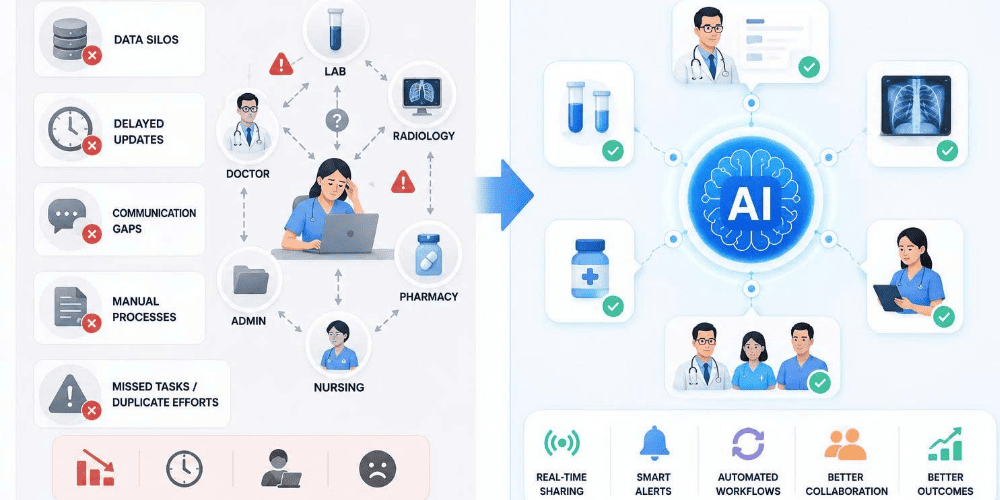
AI Assists in Care Coordination Across Healthcare Departments (Source: Internet)
Modern healthcare delivery involves collaboration among multiple specialties, departments, and care teams. While Electronic Medical Record (EMR) systems have improved access to patient information, many healthcare organizations still face challenges that affect both care coordination and overall healthcare operations.
- Data silos across departments: This often forces healthcare professionals to spend valuable time searching for and verifying information.
- Delayed patient status updates: Critical changes may not reach the appropriate teams quickly enough.
- Inconsistent communication between care teams: This increases the risk of misunderstandings and missed information.
- Heavy reliance on manual coordination processes: Staff often spend excessive time on administrative tasks instead of patient care.
- Missed tasks or duplicated efforts: These issues can negatively impact both operational efficiency and service quality.
These challenges affect not only operational performance but also patient outcomes and satisfaction. As healthcare systems become increasingly complex, AI in healthcare is emerging as a valuable solution for improving care coordination, reducing communication gaps, and supporting better healthcare workflow automation.
How AI Connects Departments Across Healthcare Organizations
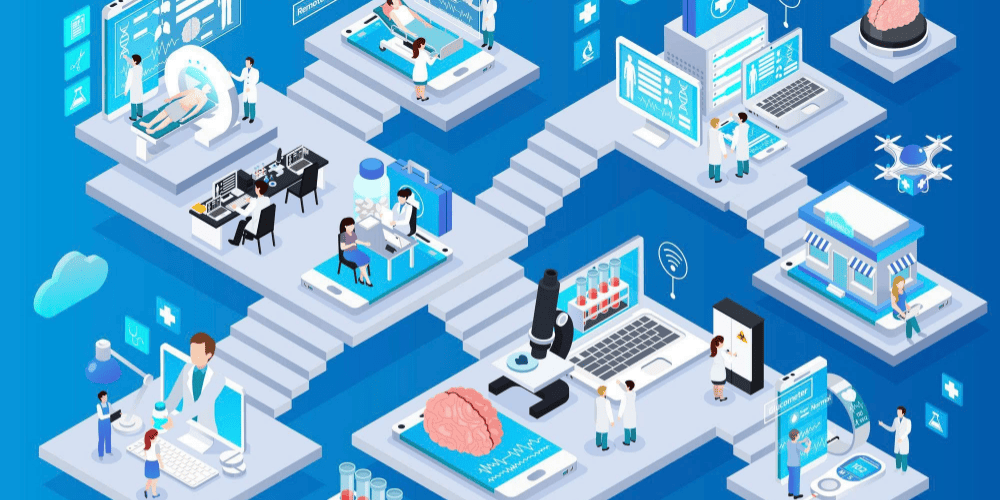
AI connects different parts of an organization. (Source: Internet)
AI in healthcare acts as an intelligent coordination layer that connects data, workflows, and communication channels across healthcare organizations. By enabling real-time information sharing and care team collaboration, AI streamlines healthcare operations, reduces administrative workload, and supports faster decision-making and better patient care.
Breaking Down Data Silos
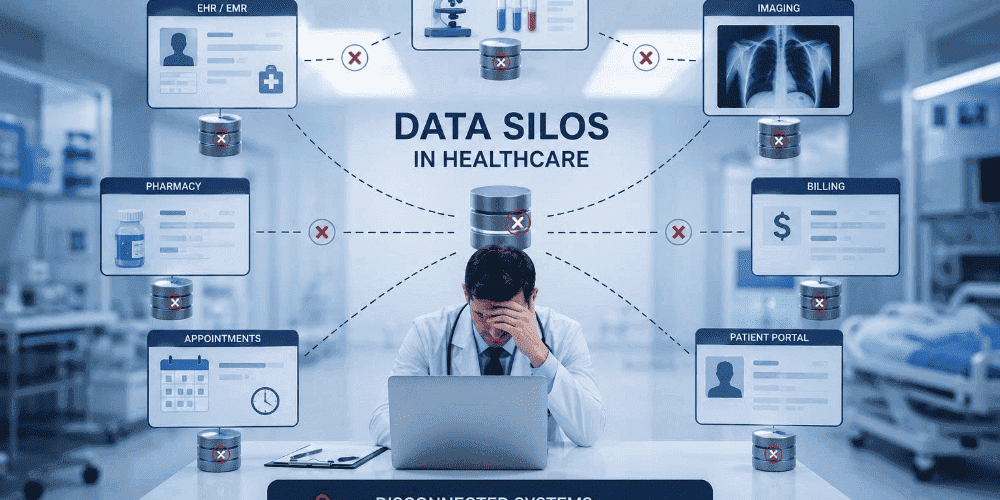
Doctor Facing the Challenge of Fragmented Healthcare Data (Source: Internet)
One of the most valuable applications of AI in healthcare is its ability to consolidate and improve patient data management across multiple systems. Patient information is often stored across separate systems, including:
- Electronic Medical Record (EMR) Systems: Store patient medical histories, clinical documentation, diagnoses, medications, and treatment information.
- Laboratory Information Systems: Provide test results that support diagnosis and treatment decisions.
- Medical Imaging Systems: Manage imaging data such as X-rays, CT scans, MRIs, and other diagnostic results.
- Appointment Scheduling Systems: Track appointments and help manage patient flow.
- Patient Communication Channels: Capture interactions, feedback, and support requests from patients.
- Billing and Administrative Systems: Support financial operations and organizational management.
When these systems operate independently, healthcare professionals often need to switch between multiple platforms to gather information. AI in healthcare helps aggregate data, create connected patient records, and surface relevant insights based on context. By reducing healthcare data silos, organizations can improve patient data sharing, strengthen collaboration between departments, and support more informed clinical decision-making.
Enhancing Patient Data Sharing
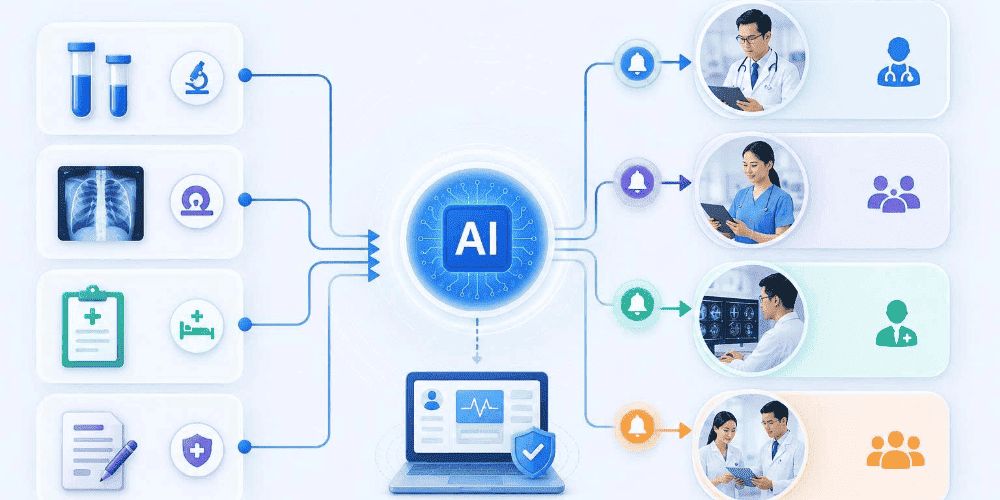
Intelligent Healthcare Data Sharing ( Source: Internet )
Timely access to information is essential for effective clinical decision-making and successful care coordination. One of the key advantages of AI in healthcare is its ability to support real-time patient data sharing across departments.
AI can automatically identify important changes within patient records and distribute relevant updates to the appropriate teams.
- Lab results are sent directly to physicians and nursing staff: This helps care teams respond more quickly to changes in patient conditions.
- Medical imaging results are routed to specialists for review: This supports faster and more accurate clinical decision-making.
- Discharge information is shared with follow-up care teams: This helps maintain continuity of care after a patient leaves the healthcare facility.
- Treatment plan updates are communicated to all relevant stakeholders: This ensures every department works from the same source of information.
Through improved patient data sharing and connected patient records, AI helps healthcare organizations maintain better visibility throughout the patient journey while reducing delays caused by fragmented communication.
Streamlining Care Coordination Workflows

AI Optimizes Healthcare Processes Across Departments (Source: Internet)
A patient’s treatment journey typically involves multiple stages, including initial consultations, diagnostic testing, specialist evaluations, treatment, and follow-up care. Each stage requires effective care coordination among different departments, meaning delays in one area can affect the entire process. Manual coordination often consumes significant time and places additional pressure on healthcare teams, creating challenges for both patient care and overall healthcare operations.
This is where AI in healthcare can make a meaningful impact. By monitoring care workflows, identifying bottlenecks, and automatically triggering the next steps when predefined conditions are met, AI supports more efficient healthcare workflow automation across departments. As a result, healthcare organizations can improve operational performance, strengthen collaboration between care teams, and allow clinicians to focus more on delivering high-quality patient care.
Reducing Internal Communication Error
Communication failures remain one of the most common causes of inefficiencies in healthcare operations. Missed notifications, incomplete updates, and unclear handoffs can negatively affect both patient care and organizational performance.
AI in healthcare helps reduce these challenges through several automation capabilities:
- Automated notifications and reminders: Ensure that the right people receive critical information at the right time.
- Task completion tracking: Helps prevent missed responsibilities and duplicate efforts.
- Real-time workflow monitoring: Allows organizations to identify delays before they become larger problems.
- Detection of missing or incomplete data: Helps ensure patient records remain accurate and comprehensive.
- Priority alerts for urgent situations: Enable healthcare teams to respond more quickly to critical cases.
By standardizing communication through AI-powered healthcare workflows, organizations can strengthen care team collaboration, improve transparency, and reduce operational risk.
Delivering a More Seamless Patient Experience

AI Improves the Patient Experience in Healthcare (Source: Internet)
Ultimately, patients care less about departmental structures and more about receiving a smooth, coordinated experience. Stronger care coordination and better patient engagement create meaningful benefits throughout the healthcare journey.
Patients can experience:
- Faster treatment timelines: Better coordination reduces unnecessary delays throughout the care process.
- Less need to repeat information: Patient data is shared across departments rather than repeatedly requested.
- More consistent and continuous care: All teams can access the same records and treatment plans.
- Clearer communication from healthcare providers: Patients gain a better understanding of their condition and next steps.
- Reduced administrative burden and waiting times: AI automates many behind-the-scenes operational tasks that affect the patient experience.
These improvements demonstrate how AI in healthcare supports coordinated care, strengthens patient engagement, and creates a more connected healthcare ecosystem.
The Future of AI-Powered Care Coordination
As digital transformation accelerates, AI in healthcare will play an increasingly important role in advancing care coordination, improving patient data management, and supporting healthcare workflow automation.
Future AI systems will move beyond information sharing to proactively identify workflow bottlenecks, predict operational challenges, and recommend actions that improve collaboration between departments. Organizations that adopt AI-powered healthcare workflows alongside EMR infrastructure will be better positioned to optimize healthcare operations, improve service quality, and deliver more connected patient experiences.
Conclusion
AI in healthcare is transforming how hospitals and clinics coordinate care by connecting departments, improving patient data sharing, streamlining workflows, and reducing communication errors. As healthcare systems become more complex, strong care coordination, effective healthcare workflow automation, and connected data management will become increasingly important.
More than just an automation tool, AI in healthcare provides the foundation for a connected, efficient, and patient-centered healthcare ecosystem. By eliminating healthcare data silos, enabling AI-powered healthcare workflows, and supporting collaboration across care teams, healthcare organizations can improve both operational efficiency and patient outcomes.
Learn how Lifesup AI helps healthcare organizations optimize operations, improve care coordination, and build AI-powered healthcare workflows tailored to modern clinical environments. Contact our team today to explore what’s possible.
>>Read more: : 10 Best AI tools for HR in 2026 for hiring and workforce management