

In today’s landscape, content creation is no longer just about creativity—it also demands speed, consistency, and the ability to optimize across multiple platforms. However, as the demand for high-quality content continues to grow, both individuals and businesses face increasing pressure to maintain performance while ensuring quality output.
This is where AI-powered content creation becomes a highly effective solution. Rather than replacing humans, AI acts as an intelligent creative assistant, helping streamline production processes, spark new ideas, and significantly improve content efficiency.
If you’re a beginner looking to integrate AI into your content creation workflow, this guide will give you a clear foundation and help you get started in a structured and effective way.
What is AI-Powered Content Creation? The Evolution of AI in Content Creation
What is AI-Powered Content Creation?
AI-powered content creation is the use of artificial intelligence tools and systems to assist, enhance or automate the process of producing content.
With AI, creators can:
- Generate ideas and topics
- Produce initial drafts
- Refine messaging
- Adapt content for multiple platforms such as blogs, social media, emails, and advertisements
At its core, AI-powered content creation works as a collaborative process between humans and machines. The AI provides speed, structure, and data-driven suggestions, while humans bring creativity, strategy, and emotional intelligence to shape the final message. This synergy enables content teams to scale production efficiently while maintaining high quality and consistency.
The Evolution of AI in Content Creation
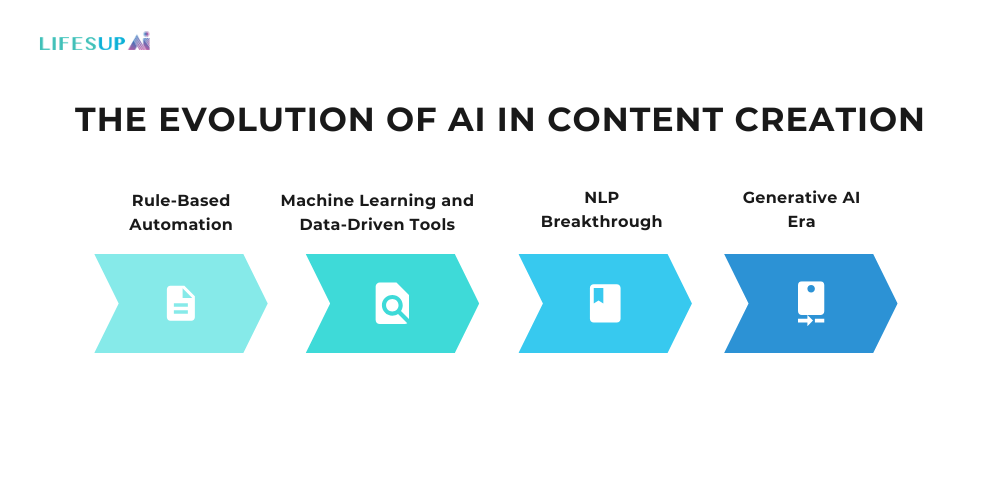
The rise of AI-powered content creation is the result of several stages of technological evolution in artificial intelligence and natural language processing.
- Rule-Based Automation: In the early days, content automation was limited to simple rule-based systems. These tools could generate basic templates or repetitive text, but lacked flexibility and creativity.
- Machine Learning and Data-Driven Tools: As machine learning advanced, AI systems began to learn from large datasets. Machine Learning in Marketing allowed tools to suggest keywords, improve grammar, and assist with SEO optimization.
- Natural Language Processing (NLP) Breakthrough: With improvements in NLP, AI became capable of understanding context, tone, and intent. This marked a major shift, enabling more natural-sounding text generation and better alignment with user prompts.
- Generative AI Era: AI-powered content creation has become a mainstream workflow, helping individuals and businesses scale content production while maintaining consistency and relevance.
The Benefits of AI-Powered Content Creation
AI-powered content creation offers many significant benefits for both individuals and businesses in the content production process.
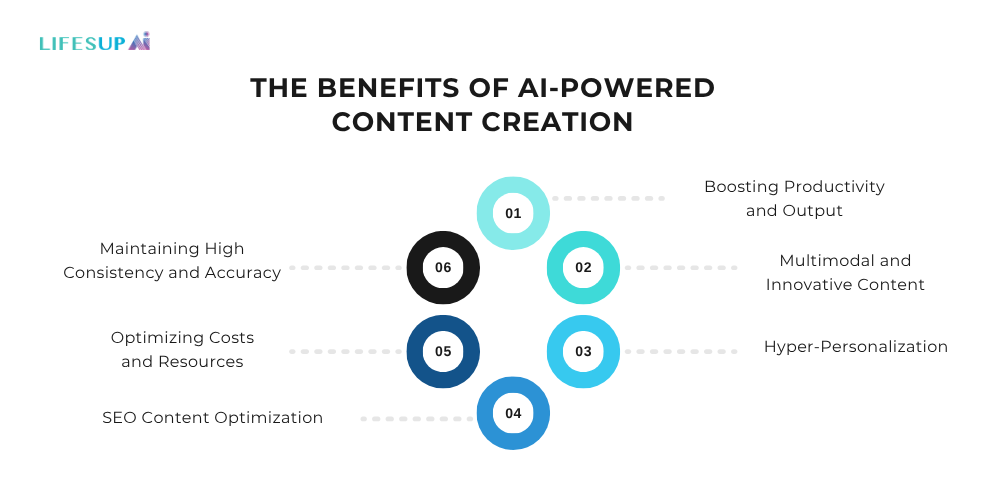
Boosting Productivity and Output
AI-powered content creation can dramatically increase productivity. Tasks that once took hours, such as drafting blog posts, writing captions, or creating outlines, can now be completed in minutes.
This allows creators and marketing teams to focus more on strategy, storytelling, and creative direction rather than repetitive execution. As a result, content output scales much faster without requiring proportional increases in effort or team size.
Multimodal and Innovative Content
AI-powered content creation supports multimodal outputs, including images, video scripts, audio content, and even interactive media.
This opens up new opportunities for brands to experiment with richer storytelling formats and more engaging user experiences. Instead of relying on a single content type, creators can build integrated campaigns across multiple formats with AI support.
Hyper-Personalization
AI can deliver highly personalized content at scale by analyzing user behavior, preferences, and engagement patterns to generate tailored messages for different audience segments.
With AI-powered content creation, brands can move beyond generic messaging and create content that feels more relevant and timely for each individual user—improving engagement and conversion rates.
SEO Content Optimization
Search engine optimization becomes significantly more efficient with AI. Tools can suggest high-performing keywords, improve content structure, optimize headings, and enhance readability.
By integrating AI-powered content creation into SEO workflows, content becomes more aligned with search intent, increasing the chances of ranking higher on search engines and attracting organic traffic more effectively.
Optimizing Costs and Resources
AI helps reduce the overall cost of content production by minimizing manual workload and reducing the need for large content teams for basic production tasks.
Instead of outsourcing or scaling headcount rapidly, businesses can use AI-powered content creation to handle foundational work, allowing human teams to focus on high-value creative and strategic activities.
Maintaining High Consistency and Accuracy
Consistency is critical in branding and communication. AI helps maintain a unified tone of voice, style, and structure across all content outputs.
When properly guided, AI-powered content creation ensures that messaging remains consistent across platforms, reducing errors and improving overall content quality control.
How to Implement AI in Content Creation
Integrating AI-powered content creation into your workflow is not just about using tools, it’s about building a structured process where AI and human input complement each other. A clear workflow ensures consistency, quality, and scalability while avoiding over-reliance on automation.
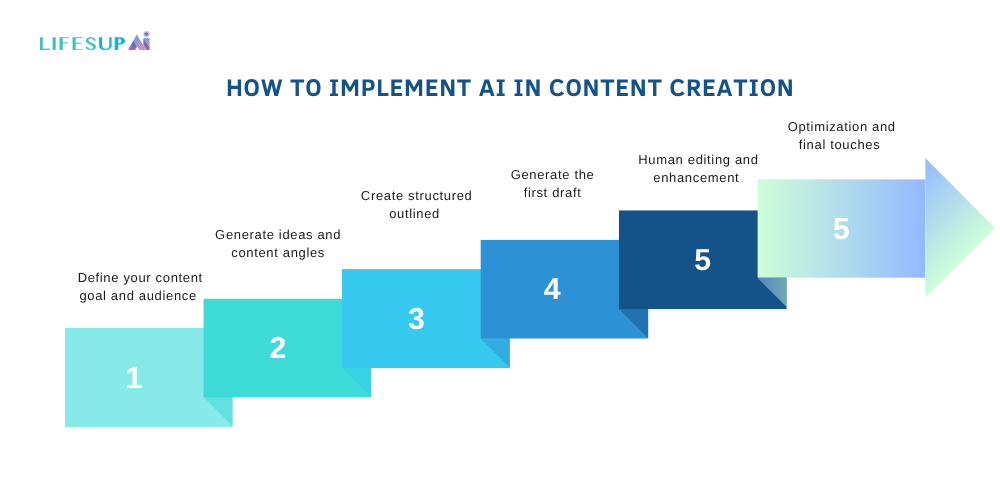
Step 01: Define your content goal and audience
Before using any AI tool, start with clarity. Identify what you want to achieve and who you are speaking to.
- Is the content for brand awareness, lead generation, or SEO traffic?
- Who is your target audience (demographics, interests, pain points)?
- What tone of voice should the content reflect?
Even the most advanced AI-powered content creation tools perform best when given clear direction.
Step 02: Generate ideas and content angles with AI
Once your goal is clear, use AI to brainstorm ideas, headlines, and content angles.
- At this stage, AI can help you:
- Generate topic clusters based on keywords
- Suggest engaging titles and hooks
- Explore different storytelling angles
- Identify trending or relevant themes
This step reduces creative blocks and speeds up the planning phase significantly.
Step 03: Create structured outlined
Instead of jumping directly into writing, use AI to build a strong content structure – an essential step in AI Content Marketing. A good outline typically includes:
- Introduction
- Key sections and subheadings
- Supporting points or data ideas
- CTA (call-to-action) placement
With AI-powered content creation, outlines can be generated in seconds and refined by human input to ensure strategic alignment.
Step 04: Generate the first draft with AI
Next, use AI to produce a full draft based on your outline. This is where AI saves the most time. However, the output should be treated as a foundation – not a final version. The draft may require:
- Fact-checking
- Tone adjustment
- Brand voice alignment
- Structural refinement
The key principle of AI-powered content creation is collaboration, not automation-only output.
Step 05: Human editing and enhancement
This is where human creativity becomes essential. Review and refine the AI-generated content to ensure quality and authenticity. Focus on:
- Adding storytelling elements
- Improving emotional connection
- Strengthening arguments or insights
- Removing repetitive or generic phrasing
This step transforms raw AI output into high-quality, publish-ready content.
Step 06: Optimization and final touches
Before publishing, optimize the content for search engines and readability. Key actions include:
- Adding primary and secondary keywords naturally
- Optimizing headings (H1, H2, H3 structure)
- Improving readability and flow
- Adding internal/external links if needed
With AI-powered content creation, many SEO suggestions can be generated automatically, but final decisions should always be human-driven.
Step 07: Publish, analyze, and improve
After publishing, the workflow doesn’t end. Monitor performance and use insights to improve future content.
What you need to track:
- Traffic and engagement
- Conversion rates
- Keyword rankings
- Audience behavior
These insights can be fed back into your AI-powered content creation process to continuously refine prompts, topics, and strategies.
>> Read more: Best AI-Powered Marketing Tools to Use in 2026
Best practices for using AI Content effectively without violating Google policies
Focus on people-first content
Google prioritizes content that is created for people, not search engines. This means your content should:
- Answer real user questions clearly
- Provide original insights or value
- Avoid being overly generic or repetitive
- Solve a specific problem or need
Even when using AI-powered content creation, always ensure the final output is meaningful and genuinely helpful to readers.
Ensure accuracy and fast-checking
AI can sometimes generate outdated or incorrect information. That’s why human verification is essential. Before publishing, always:
- Check factual claims
- Verify statistics and data
- Cross-reference reliable sources
Maintaining accuracy is critical for both SEO performance and brand credibility.
Add original insights and expertise
To stand out in search rankings, your content should include something AI alone cannot provide – real human experience.
You can improve AI-powered content creation by adding:
- Case studies or real examples
- Personal opinions or expert commentary
- Industry-specific insights
- Unique data or research
This helps differentiate your content from generic AI-generated material.
Avoid low-quality and mass-produced content
Google discourages scaled content that is created primarily to manipulate rankings. This includes:
- Thin or repetitive articles
- Keyword-stuffed pages
- Content with no added value or originality
If you’re using AI-powered content creation at scale, always prioritize quality over quantity. Fewer high-quality pieces will perform better than hundreds of low-value pages.
Popular AI-Powered Content Creation Tools Today
ChatGPT
ChatGPT is one of the most widely used AI tools for AI-powered content creation, known for its versatility in generating ideas, writing drafts, and improving content quality.
Key Features:
- Blog writing, article drafting, and content ideation
- Brainstorming headlines, hooks, and outlines
- Editing and rewriting assistance
- Multi-purpose use (SEO, social media, email, scripts)
- Strong conversational interface for prompt-based creation
Grammarly
Grammarly is widely known for editing, but its AI features now support content generation and rewriting as well.

Key Features:
- Grammar, spelling, and tone correction
- AI-powered rewriting and clarity improvements
- Style consistency across documents
- Real-time suggestions in browsers and apps
- Plagiarism detection and readability enhancement
Notion AI
Notion AI integrates directly into productivity workflows, making it ideal for content planning and documentation.
Key Features:
- Content outlines and blog drafts inside Notion workspace
- Meeting notes summarization and task generation
- Idea generation for content calendars
- Team collaboration for planning and execution
- Workflow integration for content teams
Jasper AI
Jasper is designed specifically for marketing teams and is widely used for scalable, brand-consistent content production.
Key Features:
- Brand voice customization for consistent messaging
- Pre-built templates for ads, blogs, and emails
- Campaign-level content generation (multi-asset creation)
- Team collaboration and workflow tools
- SEO integrations for marketing optimization
Lifesup AI
Lifesup AI provides a comprehensive AI-powered content creation solution that helps businesses optimize the entire content production process—from ideation and creation to performance optimization.
By combining Generative AI with data analytics, Lifesup AI enables the creation of high-quality, personalized content tailored to specific audiences, while seamlessly integrating into existing systems. In addition, the platform leverages AI Gamification to boost engagement and enhance user experience.

Key features:
- Automated end-to-end content production workflows
- Scalable and consistent content creation
- Data-driven content personalization
- AI Gamification to increase engagement
- Workflow and performance optimization
- Flexible customization based on business needs
Discover our case studies here.
The future of AI-Powered Content Creation
In the future, AI-powered content creation will go beyond simply supporting creators and evolve into a fully intelligent content engine. AI will be capable of independently researching trends, identifying content gaps, and building data-driven content strategies tailored to specific audiences and business goals.
AI-powered content will also become real-time adaptive, with websites, ads, and even articles automatically adjusting based on each user’s behavior and preferences. This shift will enable more personalized experiences and maximize engagement. In addition, AI will act as a creative partner, not only executing tasks but also suggesting new ideas, predicting trends, and helping brands stay ahead of the curve.
Ultimately, AI-powered content creation will move toward end-to-end automation, while humans focus on strategy, creativity, and long-term vision.
In conclusion, AI-powered content creation is a powerful tool that helps beginners create content faster, smarter, and more effectively when combined with human creativity and strategy.
If you’re looking for a more scalable and efficient approach, Lifesup AI offers a comprehensive AI marketing solution from content creation to automation and customer engagement. Explore how Lifesup AI can elevate your content strategy today.