
Chatbots have come a long way since their inception as simple customer service tools. Today, chatbots play a much larger role in businesses, from sales and marketing to customer engagement and support. In this article, we will learn about the evolution of chatbots and explore how businesses leverage this technology to improve their operations.
History of Chatbots
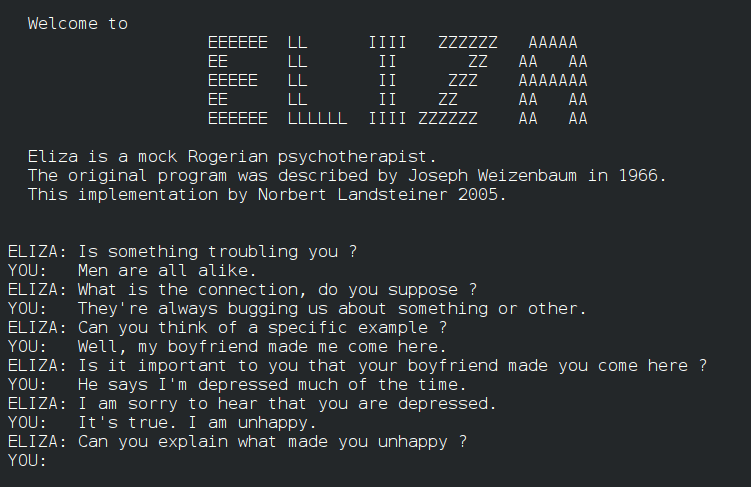
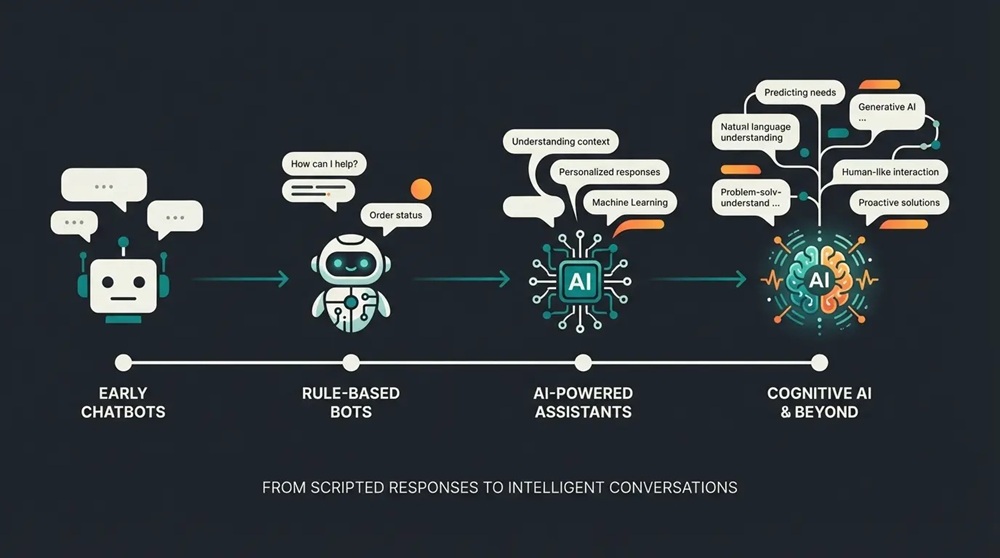
The first chatbot, ELIZA, was developed in 1966 at the MIT Artificial Intelligence Laboratory by Joseph Weizenbaum. ELIZA operated by identifying keywords and generating pre-programmed responses, without any real understanding of human language. This marked the earliest stage in the evolution of chatbots, when systems were entirely rule-based and limited in capability.
In the early 2000s, with the rise of the Internet, chatbots such as ALICE emerged, marking a significant step forward in conversational simulation and serving as the foundation for many later chatbot systems.
During the 2010s, the evolution of chatbots accelerated with the introduction of virtual assistants such as Siri, Google Assistant, Cortana, and Alexa brought chatbots closer to everyday users by supporting basic tasks like information retrieval, messaging, navigation, and schedule management. In their early stages, chatbots were primarily applied in customer service to provide 24/7 support for businesses. However, their rule-based design limited their ability to understand language and context, resulting in rigid and impersonal responses.
Around 2016, with the rapid advancement of artificial intelligence, machine learning, and natural language processing (NLP), chatbots entered a new phase of development. They became more intelligent, capable of learning from data, better understanding context, and were increasingly adopted across various fields such as customer support, sales, marketing, and business operations.
Chatbots Today
Today, chatbots play an increasingly important role in business operations, ranging from sales and marketing to customer interaction and support. Many organizations deploy chatbots to provide 24/7 customer service, automatically answer frequently asked questions, offer product consultations, and assist with faster deal closure.
In sales and marketing, chatbots enable personalized customer experiences by collecting and analyzing data on customer needs, behaviors, and preferences. Based on this information, chatbots can deliver relevant product or service recommendations and even participate in managing the entire sales process. This personalized approach is significantly more effective than traditional mass marketing campaigns.
Beyond sales and marketing, chatbots are widely applied across other business functions. In human resources, chatbots support recruitment, handle internal inquiries, guide onboarding processes, and help manage employee information. In operations and IT, chatbots assist in receiving requests, resolving basic issues, and facilitating access to internal documentation, thereby reducing the workload of specialized teams. In finance and accounting, chatbots are used to support invoice lookup, payment status tracking and basic reporting tasks.
With their growing ability to understand human language and context, chatbots deliver more natural and engaging interactions. As a result, they help improve operational efficiency, enhance user experience, and build trust and brand loyalty – factors that are especially critical in experience-driven industries such as retail, finance, healthcare, and services.
The Future of Chatbots
The future of chatbots is closely tied to the advancement of AI, particularly machine learning, natural language processing, and generative AI. Chatbots are evolving from simple conversational tools into intelligent digital assistants capable of understanding context, handling complex requests, and supporting real-time decision-making.
In the coming years, chatbots are expected to become more proactive and automate a wide range of business processes, from customer service to internal operations. Integration with enterprise systems such as CRM and ERP enables chatbots to deliver deeper personalization and improve overall work efficiency.
At the same time, data security, privacy, and responsible AI will become critical considerations. When implemented effectively, AI-powered chatbots help organizations optimize operational costs, enhance productivity, and create sustainable competitive advantages in the digital business landscape. Overall, chatbots are expected to play a central role in enterprise digital transformation.
One of the key trends
The future of chatbots is also likely to see the development of virtual assistants that can handle a wider range of tasks, from scheduling appointments to managing finances. These virtual assistants will use AI and machine learning to learn about their users and provide tailored support, making our lives easier and more efficient.
Another trend likely to gain momentum in the coming years is the integration of chatbots with voice assistants such as Amazon’s Alexa and Google Home. This will allow businesses to reach even more customers as voice assistants become increasingly popular in homes and workplaces worldwide.
Conclusion
In conclusion, the evolution of chatbots has been a remarkable journey, and they are now playing a critical role in businesses, from customer service and support to sales and marketing. With the rapid development in Artificial intelligence and machine learning, it’s clear that chatbots will continue to play an important role in the future of businesses. Businesses that invest in chatbots today will be well-positioned to take advantage of this technology and reap the benefits of improved customer engagement, reduced costs, and increased sales and marketing effectiveness.
As businesses embrace chatbots, staying informed about the latest developments and trends in this rapidly evolving technology is crucial. With the right strategies and tools in place, businesses can leverage the power of chatbots to accomplish their goals and stay ahead of the competition
Connect with Lifesup AI now to receive expert guidance and deploy a versatile AI Chatbot solution that perfectly fits your business model.
Read more: What Is an AI Chatbot? Benefits & Real-World Business Use Cases